Why Does My Toilet Water Level Drop by Itself?
A toilet bowl that loses water on its own usually has one of four problems. Gerber, a toilet manufacturer, lists them as a partial clog that slowly siphons water out of the bowl, not enough water in the tank, blocked vent pipes, and a hairline crack in the bowl's trapway (Gerber). Korky adds a fifth that is easy to miss: the refill tube in the tank isn't sending water back to the bowl after a flush (Korky).
Expert review in progress A licensed plumber has not reviewed this guide yet. When that review is done, the reviewer’s name, license and the review date will appear here.
In this guide
Mark the water line in the bowl with a piece of tape and check it a few hours later. If it drops while nobody uses the toilet, work through the checks below in order.
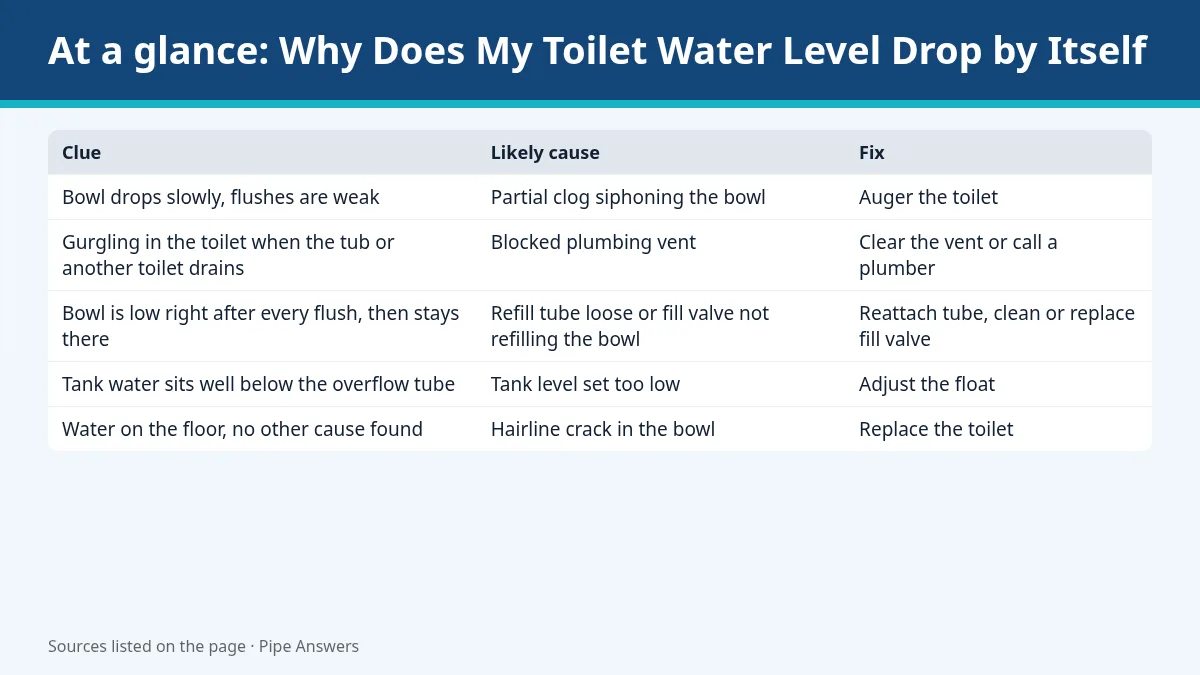 Graphic: summary of this guide, made by our team from the cited sources.
The five causes at a glance
| Clue | Likely cause | Fix |
|---|---|---|
| Bowl drops slowly, flushes are weak | Partial clog siphoning the bowl | Auger the toilet |
| Gurgling in the toilet when the tub or another toilet drains | Blocked plumbing vent | Clear the vent or call a plumber |
| Bowl is low right after every flush, then stays there | Refill tube loose or fill valve not refilling the bowl | Reattach tube, clean or replace fill valve |
| Tank water sits well below the overflow tube | Tank level set too low | Adjust the float |
| Water on the floor, no other cause found | Hairline crack in the bowl | Replace the toilet |
Sources: Gerber; American Standard; Korky.
Check 1: The refill tube and tank level
Take the tank lid off and flush. Korky says the small refill tube from the fill valve should be connected and pointing into the overflow tube; if it is loose, refill water goes into the tank instead of the bowl (Korky). Some fill valves also have a bowl refill dial; if it is closed, turn it fully open and flush again.
While the lid is off, look at where the tank water stops. Manufacturers give slightly different targets: American Standard says about 1/4 to 1/2 inch below the top of the overflow tube (American Standard), and Gerber says about 1 inch below (Gerber). Follow the mark on your fill valve or your toilet's manual. If the tank is much lower, see our guide to adjusting the toilet water level.
This cause makes the bowl low after a flush. It doesn't make the level fall over a few hours. If the level keeps falling between flushes, keep going.
Check 2: A partial clog
A wad of paper or a small object caught in the trapway can act like a wick or start a slow siphon that pulls water out of the bowl. Gerber recommends a closet auger with a bulb head to clear the trapway (Gerber). A closet auger is designed not to scratch the porcelain; a regular drain snake can.
Check 3: A blocked vent
Listen at the toilet while someone drains the tub or flushes another toilet. Gerber says gurgling at that moment means the vents are likely blocked and the suction in the pipes is pulling air through the toilet and emptying the bowl (Gerber). The Wisconsin Department of Health Services suggests checking the roof plumbing vent for leaves or bird nests (Wisconsin DHS). Getting on the roof is risky; a plumber can clear the vent safely.
Check 4: A hairline crack
If none of the above explains it, look for water on the floor around the base of the toilet. Gerber notes you may need to pull the toilet to see the subfloor on a tiled floor, and that water there probably means a cracked bowl, which has to be replaced (Gerber). American Standard also says a cracked bowl needs replacing (American Standard). Shut off the supply valve and stop using the toilet if you find standing water, so it doesn't damage the floor.
Why it matters
The water in the bowl is what keeps sewer gas out of the bathroom. If the level drops low enough, you may notice a sewer smell. If the toilet also refills by itself every few minutes, that is a separate tank-to-bowl leak; see why a toilet runs every few minutes.
Frequently asked questions
Is it normal for toilet water to go down overnight?
A small drop from evaporation in a toilet that sits unused for days is normal. A visible drop overnight in a toilet you use daily usually means siphoning from a partial clog or a vent problem, or a crack.
Can a blocked vent make the toilet bowl lose water?
Yes. Gerber says gurgling from the toilet when another toilet or the tub drains points to blocked vents, which can pull water out of the bowl.
How do I know if my toilet bowl is cracked?
Look for water on the floor around the base when you can't find any other cause. Gerber and American Standard both say a cracked bowl has to be replaced.
Can low water in the bowl cause a sewer smell?
It can. The water in the bowl is the seal that blocks sewer gas. If it drops low enough, odors can come up through the toilet.
Smell gas? Leave the building without switching anything on or off, then call your gas utility or 911 from outside.
Know your shutoff. Find your home’s main water shutoff before you need it. Most fixtures also have their own small valve.
Sources
- Why is the toilet bowl water level low?, Gerber Plumbing Fixtures
- How do I adjust the water level in the toilet bowl if it is low?, American Standard
- How to Fix a Toilet Bowl That Won't Refill After Flushing, Korky
- Air: Sewer Gas, Wisconsin Department of Health Services
Spotted an error? See our corrections policy or email contact@pipeanswers.com.

Pipe Answers Editorial Team
Our editors build each guide from the sources listed above and check every claim and number against them before publishing. How the team works
Related guides
-
 Toilets
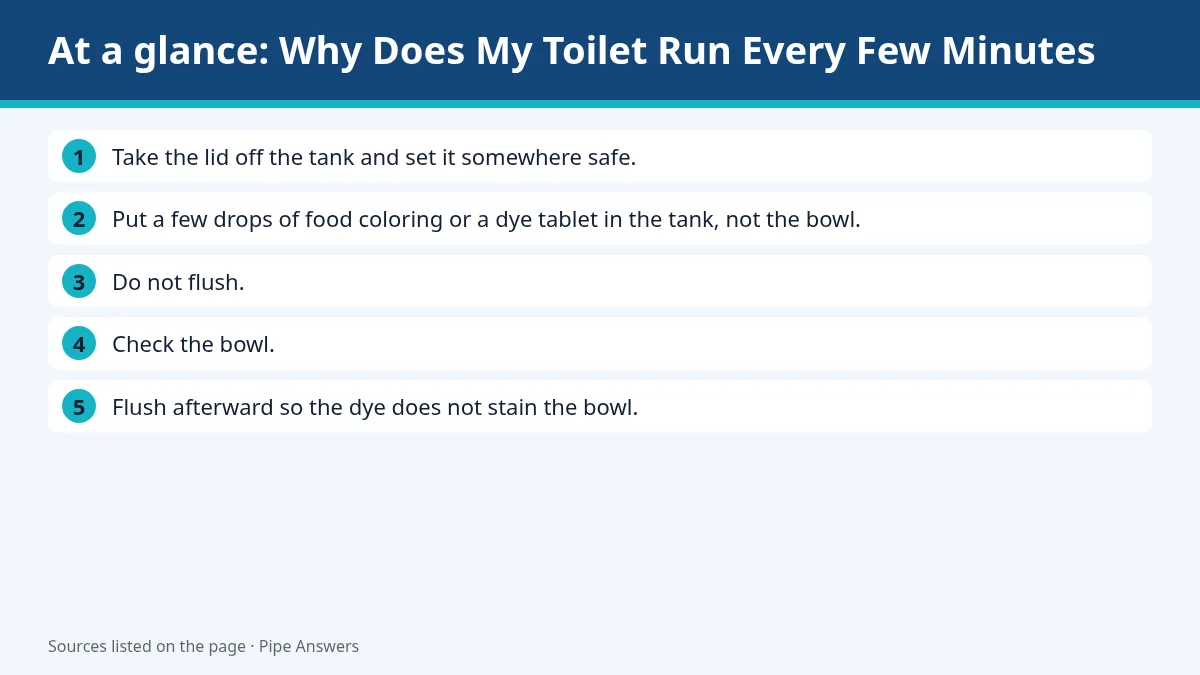
 Why Does My Toilet Run Every Few Minutes? (Phantom Flush Fix)
A toilet that refills by itself every few minutes is leaking tank water into the bowl, often past a worn flapper. Confirm it with a dye test, then fix it.
-
 Winterizing
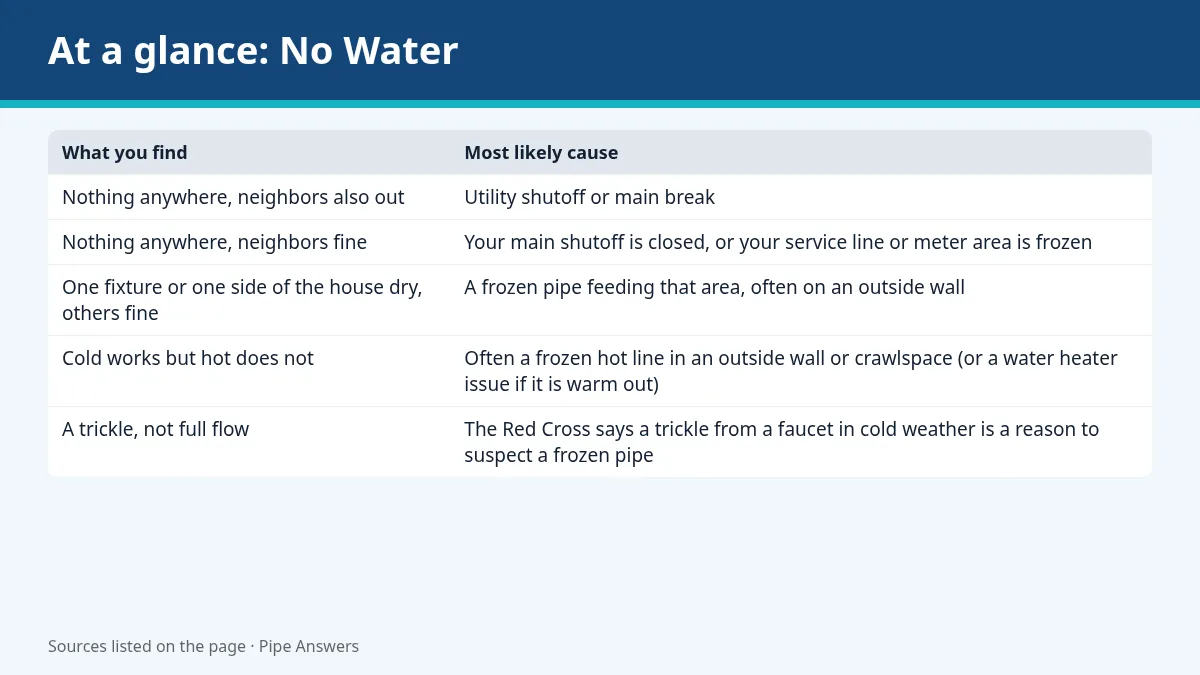
 No Water? How to Tell if Your Pipes Are Frozen or the Water Is Off
Neighbors have water but your faucets give nothing or a trickle in freezing weather? A pipe is probably frozen. How to check and how to thaw it safely.
-
 Drains & Clogs
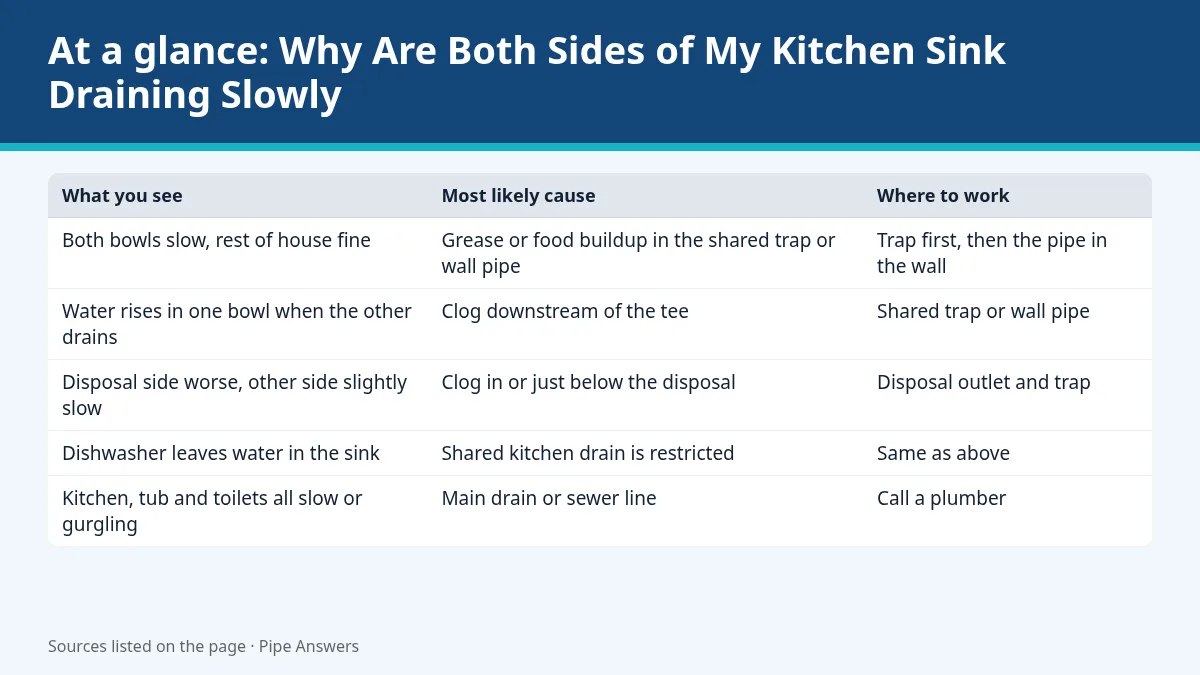
 Why Are Both Sides of My Kitchen Sink Draining Slowly?
When both bowls of a double kitchen sink drain slowly, the clog is usually past the point where the two drains join, in the trap or the pipe in the wall. How to find it and clear it.
-
 Water Pressure
 Low Water Pressure in Only One Faucet? Check These 4 Things
If only one faucet is weak, the problem is in that faucet or its supply, not your home's pressure. Check the aerator, shutoff valves, then the cartridge.