Why Does My Shower Turn Cold After 5 Minutes?
A shower that starts hot and turns cold after about five minutes is running out of heated water too soon. With a tank water heater, the usual causes are a failed lower heating element (electric), a broken or too-short dip tube, a thermostat set too low, or simply more demand than the tank can meet. With a tankless heater, the burner may be shutting off because the flow dropped below its minimum (A. O. Smith; Bosch).
Expert review in progress A licensed plumber has not reviewed this guide yet. When that review is done, the reviewer’s name, license and the review date will appear here.
In this guide
- First, narrow it down
- Is your tank big enough for how you use it?
- Electric tank: test the lower element and dip tube
- Gas or electric tank: the dip tube
- Tankless: the burner may be shutting off
- Only the shower? Check for a crossover or the shower valve
- When to call a plumber
- Frequently asked questions
- Sources
Start by answering two questions: is it only the shower, and what kind of water heater do you have?
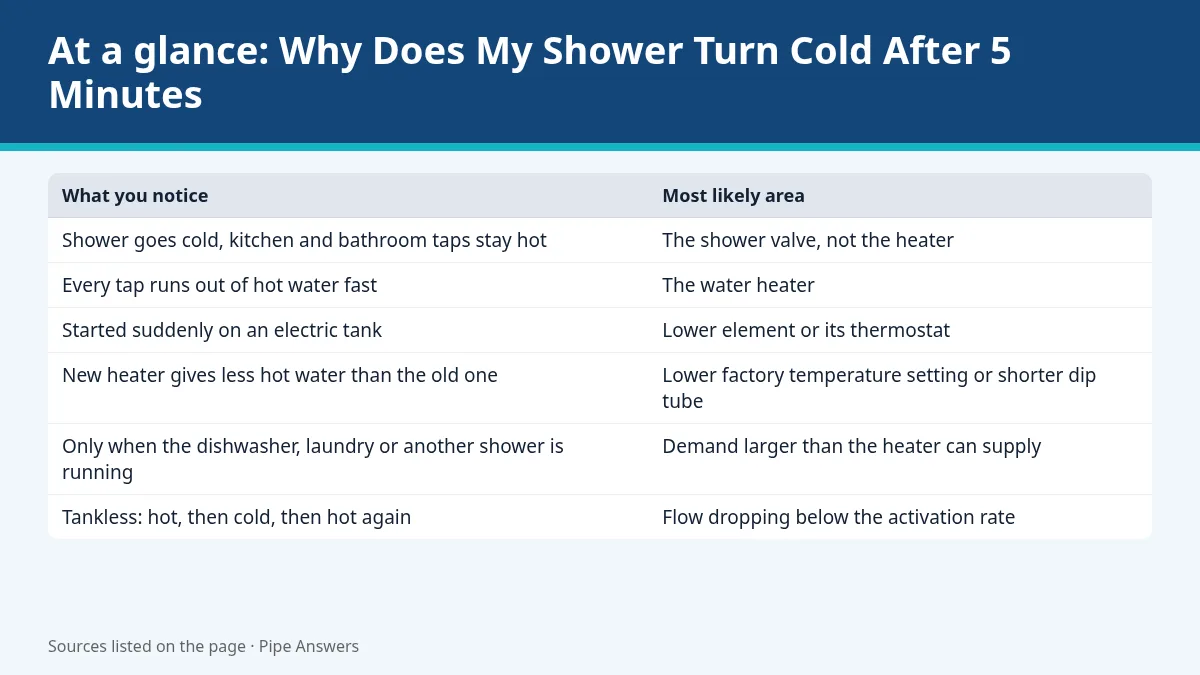 Graphic: summary of this guide, made by our team from the cited sources.
First, narrow it down
| What you notice | Most likely area |
|---|---|
| Shower goes cold, kitchen and bathroom taps stay hot | The shower valve, not the heater |
| Every tap runs out of hot water fast | The water heater |
| Started suddenly on an electric tank | Lower element or its thermostat |
| New heater gives less hot water than the old one | Lower factory temperature setting or shorter dip tube |
| Only when the dishwasher, laundry or another shower is running | Demand larger than the heater can supply |
| Tankless: hot, then cold, then hot again | Flow dropping below the activation rate |
| Gas tank: no hot water at all after it ran out | Pilot or burner issue; call a pro |
Is your tank big enough for how you use it?
Water heaters are sized by first hour rating (FHR), the gallons of hot water a full tank can deliver in an hour. The Building America Solution Center explains that the FHR should match your household's peak-hour demand (BASC). AHRI's worksheet counts 20 gallons of hot water for each shower, 14 for a dishwasher and 32 for an automatic clothes washer (AHRI).
So two showers plus a dishwasher run in the same hour is about 54 gallons of demand by that worksheet. If your heater's FHR, listed in its manual or specifications, is lower than your real peak hour, cold showers at busy times are expected, not a fault. Spreading out showers, laundry and the dishwasher is the free fix.
If the shower goes cold after five minutes even when nobody else is using hot water, keep going.
Electric tank: test the lower element and dip tube
A. O. Smith notes that newer heaters ship with lower factory temperature settings and shorter inlet (dip) tubes, both of which reduce how much hot water you get (A. O. Smith Bulletin 36). Its test for a heater that is not giving enough hot water:
- Time how long it takes to fill a 1-gallon bucket at the faucet nearest the heater. Flow in gallons per minute is 60 divided by the seconds it took.
- With power off at the breaker, set both upper and lower thermostats to 130°F, close the covers and restore power. (A. O. Smith suggests a service person if you are not comfortable with any step.)
- Run about 15 gallons of hot water, shut it off, and give the heater about 45 minutes to recover.
- Measure the hot water temperature at a nearby faucet with a candy thermometer. It should be 120°F to 140°F.
- Keep running hot water until about 60% of the tank's capacity is used (for example 24 gallons from a 40-gallon tank, 30 from a 50-gallon tank), then measure again.
- The temperature should have dropped only about 30°F.
What the results mean, per A. O. Smith: if the first reading was out of range, check the thermostats. If you lost more than 30°F by the end, check the lower element and the dip tube (A. O. Smith Bulletin 36).
Why the lower element matters: on a typical two-element heater, the upper element heats the top of the tank and the lower element heats the rest. If the lower one fails, you get a small amount of hot water from the top and then it runs cold, which is exactly the five-minute pattern.
Safety: electric water heaters run on 240 volts. Testing elements for continuity means opening covers near live terminals. Turn the breaker off and confirm the power is off, or have a licensed plumber or electrician do it. If the heater is also tripping its breaker, see our guide on why a water heater keeps tripping the breaker.
Gas or electric tank: the dip tube
Cold water enters a tank heater through a long plastic dip tube that carries it to the bottom. If the tube is cracked, missing or too short, incoming cold water mixes into the hot water at the top, and the shower cools quickly. A. O. Smith lists a "cracked, missing, or short dip tube" as a cause of not enough hot water in both its gas and electric bulletins, and has a separate bulletin on crumbling dip tubes (A. O. Smith technical bulletins).
Dip tube replacement involves shutting off water and power or gas and draining part of the tank. It is a reasonable pro job.
Tankless: the burner may be shutting off
Tankless heaters only fire when water flows above a minimum rate. Bosch's service bulletin for its gas tankless models gives an activation rate of about 0.5 gallons per minute at the lowest setting and about 1 gallon per minute at the highest, and says the burners go out if flow drops below it (Bosch). Other brands differ, so check your manual for the number.
Bosch's checklist for water going cold mid-use:
- Clean or replace the filter screen in the heater's water inlet.
- Remove and clean faucet aerators and showerheads; soak mineral deposits in vinegar.
- A hand-held shower hose may be too restrictive; a larger-diameter hose or a fixed head can raise flow.
- Clean or replace a whole-house filter if you have one.
- Do not add so much cold water at the shower valve that total hot flow falls below the activation rate. Bosch notes this happens most in late summer, when incoming water is warm.
- On a private well, keep pressure steady; Bosch lists a minimum of 30 psi during operation.
Only the shower? Check for a crossover or the shower valve
If sinks stay hot but the shower does not, the problem is probably at the shower valve. Bosch describes a crossover test: turn off the cold water supply to the water heater only, open each hot tap to hot only, and wait 5 minutes. Any water still flowing, even a trickle, means cold water is crossing into the hot side somewhere, or the scald protection in a shower valve is misadjusted (Bosch). Bosch's advice is to consult a plumber or the faucet valve maker for the repair.
Single-handle shower valves often have an adjustable limit that sets how far the handle can turn toward hot. If someone set it low, the shower never gets as hot as the taps. The valve maker's instructions show how to adjust it.
When to call a plumber
- Element, thermostat or dip tube replacement on a tank heater, unless you are comfortable working with 240-volt power or gas.
- A gas heater whose pilot or burner keeps going out, or any smell of gas. Leave the house and call the gas utility from outside.
- The crossover test shows flow on the hot side.
- The tank is too small for your household and you are weighing a replacement.
Frequently asked questions
Why does my shower go cold but the sinks stay hot?
If other taps are still hot when the shower goes cold, the water heater is probably fine and the shower valve is the suspect. Bosch's crossover test can also reveal a misadjusted scald-protection setting in a shower valve.
Can a water heater element go bad and still give some hot water?
Yes. On a two-element electric heater, the upper element can still heat the top of the tank, so you get a short burst of hot water that runs out fast. A. O. Smith's test points to the lower element and dip tube when the temperature falls too far.
How many gallons does a shower use?
AHRI's peak-hour worksheet counts 20 gallons of hot water per shower. Two or three back-to-back showers can outrun a small tank.
Why does my tankless water heater go cold in the middle of a shower?
Often the flow has dropped below the heater's activation rate, so the burner shuts off. Bosch lists clogged aerators, showerheads, filters and restrictive hand-held hoses, and adding too much cold water at the valve.
Smell gas? Leave the building without switching anything on or off, then call your gas utility or 911 from outside.
Know your shutoff. Find your home’s main water shutoff before you need it. Most fixtures also have their own small valve.
Sources
- Technical Bulletin 36: Not Enough Hot Water, Electric, A. O. Smith
- Technical Bulletins index (cracked, missing or short dip tube; thermostat differential), A. O. Smith
- Service Bulletin TWH-G1-01: Temperature fluctuation troubleshooting, Bosch Home Comfort
- Worksheet for Estimating Peak Hour Demand / First Hour Rating, AHRI
- DHW First Hour Rating, Building America Solution Center (PNNL)
Spotted an error? See our corrections policy or email contact@pipeanswers.com.

Pipe Answers Editorial Team
Our editors build each guide from the sources listed above and check every claim and number against them before publishing. How the team works
Related guides
-
 Water Heaters
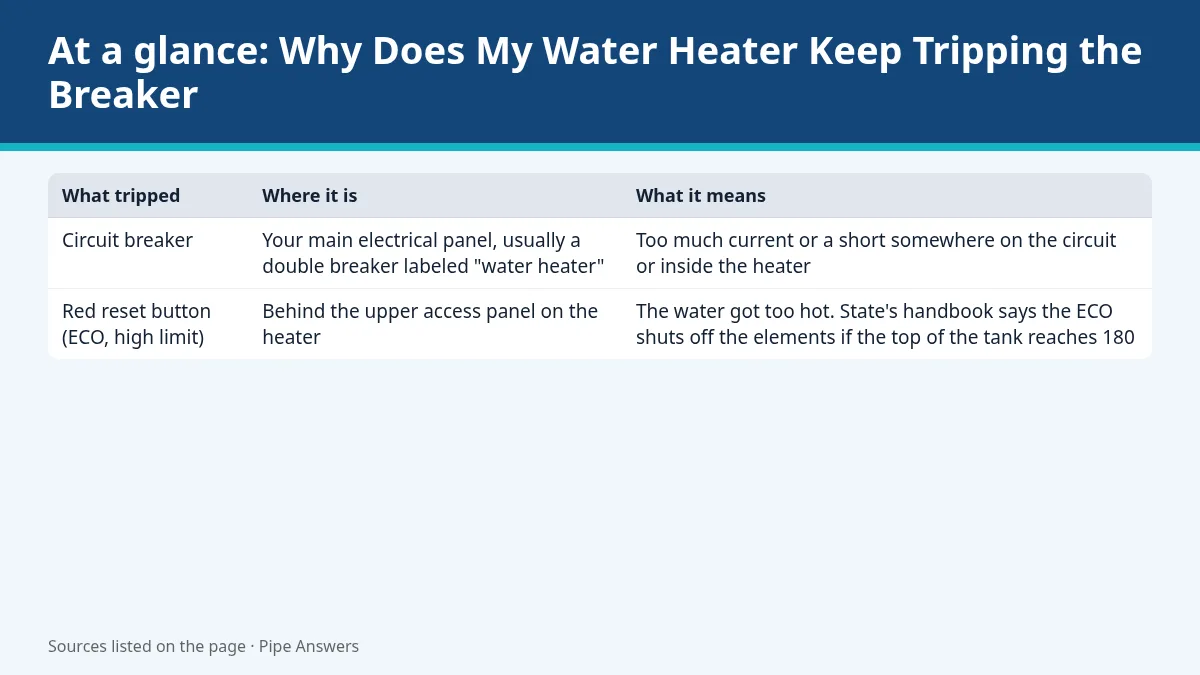
 Why Does My Water Heater Keep Tripping the Breaker? Causes and What to Do
An electric water heater that keeps tripping its breaker usually has a shorted heating element, a wiring fault or a failing breaker. What to check safely.
-
 Winterizing
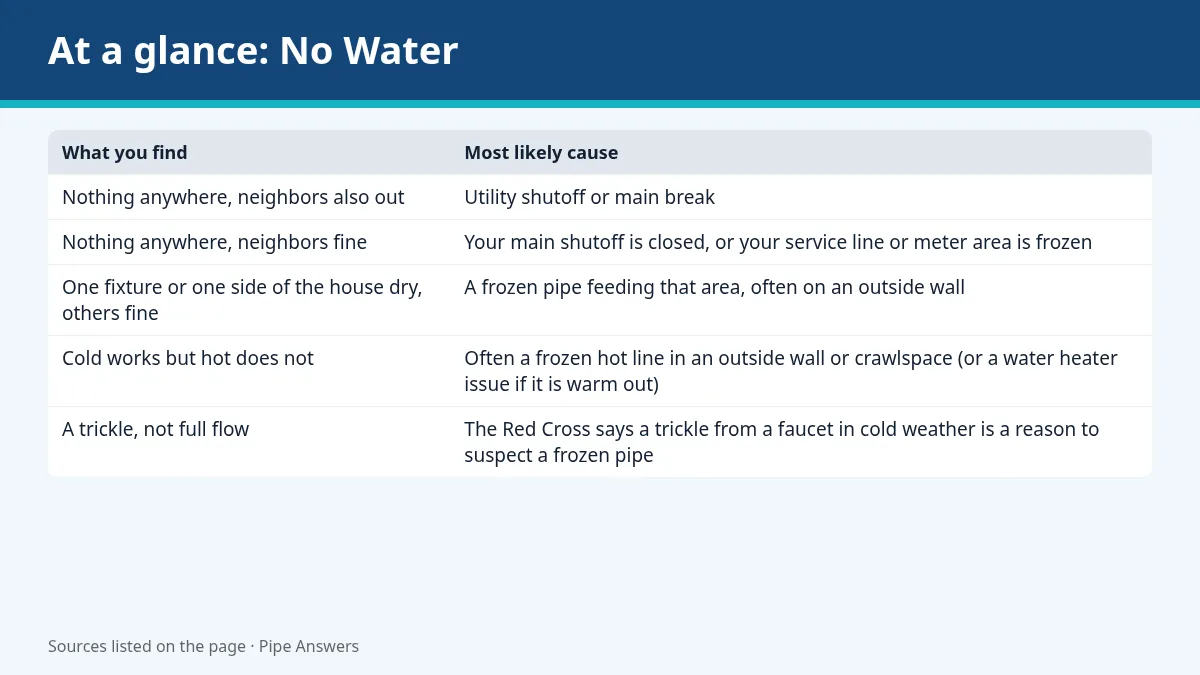
 No Water? How to Tell if Your Pipes Are Frozen or the Water Is Off
Neighbors have water but your faucets give nothing or a trickle in freezing weather? A pipe is probably frozen. How to check and how to thaw it safely.
-
 Drains & Clogs
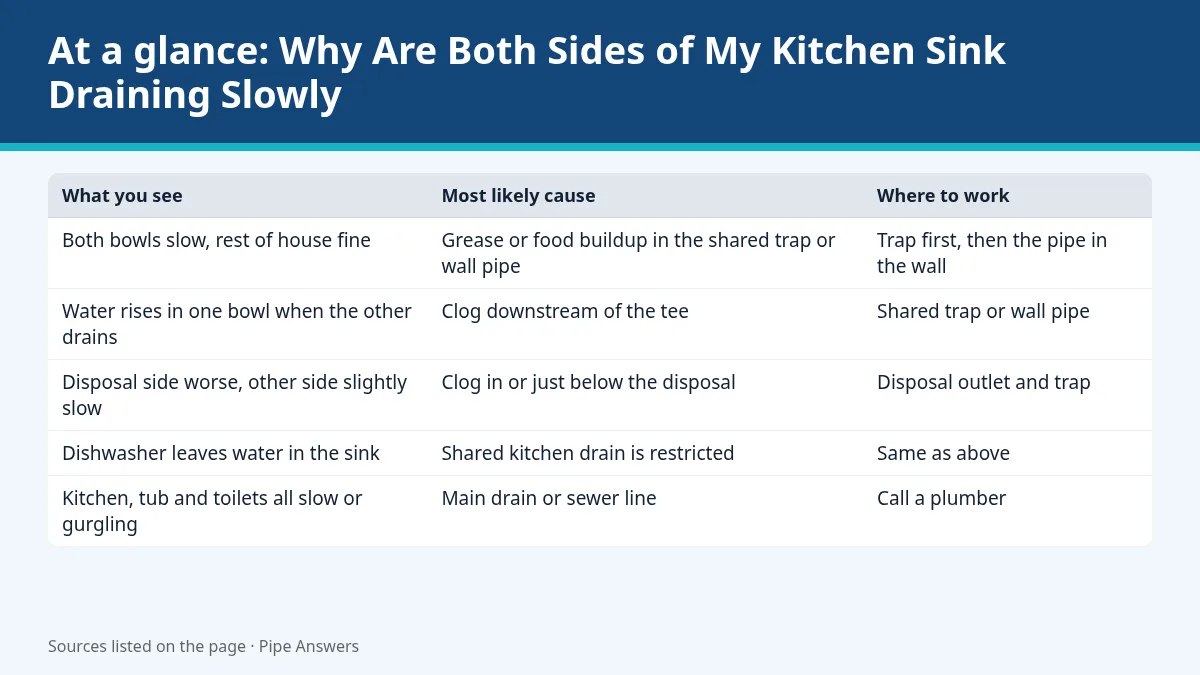
 Why Are Both Sides of My Kitchen Sink Draining Slowly?
When both bowls of a double kitchen sink drain slowly, the clog is usually past the point where the two drains join, in the trap or the pipe in the wall. How to find it and clear it.
-
 Water Pressure
 Low Water Pressure in Only One Faucet? Check These 4 Things
If only one faucet is weak, the problem is in that faucet or its supply, not your home's pressure. Check the aerator, shutoff valves, then the cartridge.