Why Does My Water Heater Keep Tripping the Breaker? Causes and What to Do
An electric water heater that keeps tripping its breaker almost always has an electrical fault: a heating element that has shorted or "grounded" to the tank, a loose or damaged wire, or a breaker that is worn out or the wrong size. Turn the breaker off and leave it off, then use the checks below to narrow it down before you call a technician or licensed electrician.

✓ Checked by a licensed plumber Kevin Orr, Texas Master Plumber License M-47441 (look it up)
Last reviewed
In this guide
A breaker is a safety device. It trips because it saw more current than the circuit should carry, or a short. Resetting it over and over does not fix that, and Rheem's manual tells owners not to attempt repairs to wiring, thermostats or heating elements themselves (Rheem manual).
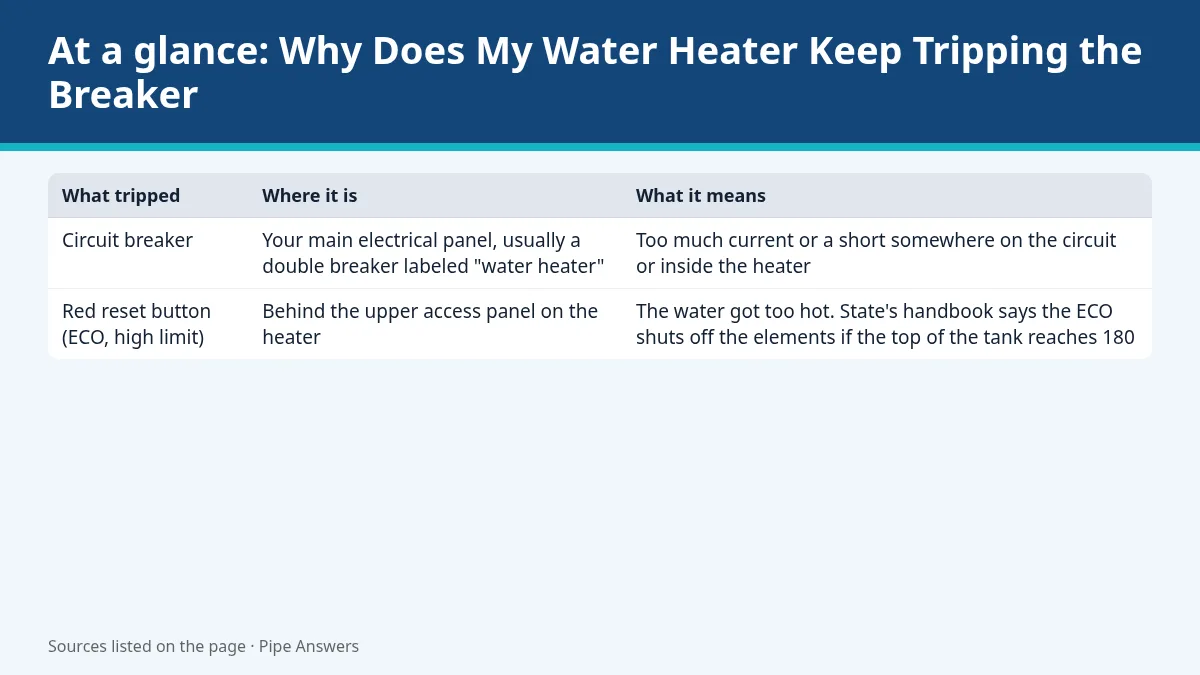 Graphic: summary of this guide, made by our team from the cited sources.
First: is it the breaker or the red reset button?
These two get mixed up all the time, and they point to different problems.
| What tripped | Where it is | What it means |
|---|---|---|
| Circuit breaker | Your main electrical panel, usually a double breaker labeled "water heater" | Too much current or a short somewhere on the circuit or inside the heater |
| Red reset button (ECO, high limit) | Behind the upper access panel on the heater | The water got too hot. State's handbook says the ECO shuts off the elements if the top of the tank reaches 180°F (State service handbook) |
If only the red button tripped, see Rheem's instructions: power off first, and the cause of the overheating has to be found by a qualified technician before the heater goes back in service (Rheem manual). The rest of this page is about the panel breaker.
The usual causes, most likely first
1. A grounded or shorted heating element
A heating element has a resistance wire inside an insulated metal sheath. The insulation keeps current away from the water and the tank. When the sheath cracks or the insulation breaks down, current can reach the tank, and the breaker trips. State's service handbook gives a continuity test between each element terminal and the tank, and says an element that shows continuity is grounded and must be replaced (State service handbook).
Clues that point here:
- The breaker holds for a while, then trips when the heater starts heating (for example, after a shower or overnight).
- The heater is older, or you have hard water and have never drained it.
2. A "dry fired" upper element (new installs and after draining)
If the power comes on before the tank is completely full, the upper element heats in air and burns out. A.O. Smith calls this a common installation mistake and tells installers to run a hot faucet at full flow for three minutes or longer before connecting power (A.O. Smith instructions). A burned element can fail open (no heat) or fail shorted (tripped breaker).
If the trips started right after the heater was installed, drained or flushed, tell the installer. A.O. Smith notes a dry-fired element is an installation error not covered by its warranty (A.O. Smith instructions).
3. Loose, burned or damaged wiring
Loose connections heat up and can arc. Look (do not touch) at the junction box on top of the heater and the cable going into it. Scorch marks, melted insulation, a burning smell or a warm cover are reasons to keep the power off and call a licensed electrician.
4. A breaker or wire that does not match the heater
The heater's rating plate lists its voltage and wattage. Whirlpool notes most residential electric units run on 240 volts, with some at 120 volts (Whirlpool). The breaker and wire must suit that rating:
- State's handbook says breakers should be sized at least 125% of the heater's expected amperage, and works the example of a 4,500-watt element at 240 volts drawing 18.75 amps (State service handbook).
- Rheem's sizing table lists a 25-amp breaker and 10 AWG copper wire for a 4,500-watt heater at 240 volts (Rheem manual).
A breaker that was fine for an old heater may be too small for a replacement with bigger elements. Breakers also wear out. Both are jobs for a licensed electrician.
5. A heater wired to run both elements at once
Most two-element tank heaters are wired so only one element heats at a time. State's handbook says the elements do not run together unless the heater was ordered with simultaneous wiring, and if they do, the amp draw doubles (State service handbook). A stuck thermostat or a wiring mistake that lets both run can overload a breaker sized for one.
6. Water where it should not be
A leak from the tank, the relief valve or a fitting above the heater can drip into the electrical compartment. If you see water or rust inside the access panel or on the floor, keep the power off. Rheem says a heater that has been through a flood should not be operated again until a qualified technician has checked it (Rheem manual).
What you can safely check yourself
Do these with the breaker off. Nothing here involves touching wires.
- Note the pattern. Does it trip instantly when you flip the breaker on, or after minutes or hours? Instant trips point to a dead short (wiring or a shorted element). Delayed trips point to an element that fails once it heats, or an overloaded circuit.
- Look for water. Check the floor, the top of the tank, and the pipes and relief valve above it.
- Look at the junction box on top of the heater for scorch marks or melted insulation. Smell for burning.
- Read the rating plate. Write down the voltage and wattage, and the size printed on the breaker handle. That gives the electrician a head start.
- Think about recent work. New heater, drained tank, new element, panel work? Mention it.
Reset the breaker once at most. If it trips again, leave it off.
What a technician will do
Expect the technician to test each element for resistance and for a short to the tank, check the thermostats, tighten or replace damaged wiring, and confirm the breaker and wire match the rating plate. A.O. Smith's troubleshooting section, for example, has the technician measure each element and replace any that read outside the expected range (A.O. Smith instructions). Element and thermostat swaps are common repairs. A leaking tank is not repairable and means replacement.
When to stop and call right away
- You see sparks, scorch marks or melted wire, or smell burning.
- There is water in the electrical compartment or around the base.
- The breaker trips instantly every time.
- The breaker panel itself feels warm or other circuits are acting up.
Call a licensed electrician for panel, breaker and wiring problems, and a licensed plumber or the manufacturer's service line for the heater itself.
Gas water heaters
A gas water heater does not have heating elements, so it rarely trips a breaker. Some models have an electric igniter or a power vent fan on a circuit; if that breaker trips, the fault is in that component. If you ever smell gas, leave the house and call your gas utility from outside.
Frequently asked questions
Is it safe to keep resetting a water heater breaker?
No. A breaker that trips again after one reset is reporting a fault. Leave it off and have the heater and circuit checked by a qualified technician or licensed electrician.
Is the red reset button on the water heater the same as the breaker?
No. The red button is the high-temperature limit (ECO) inside the heater. The breaker is in your electrical panel. They trip for different reasons.
Can a bad heating element trip the breaker?
Yes. An element whose insulation has failed can short to the tank. State's service handbook says a grounded element must be replaced.
Why did my new water heater trip the breaker right away?
A.O. Smith says a common installation mistake is turning on power before the tank is full, which burns out the upper element. Wiring or breaker sizing errors are the other usual suspects on a new install.
Smell gas? Leave the building without switching anything on or off, then call your gas utility or 911 from outside.
Know your shutoff. Find your home’s main water shutoff before you need it. Most fixtures also have their own small valve.
Sources
- Residential Electric Water Heater Service Handbook (STC082), State Water Heaters
- Residential Electric Water Heater Installation and Operating Instructions, A.O. Smith
- Residential Electric Water Heater Use and Care Manual, Rheem
- Electric Water Heater Repair and Troubleshooting, Whirlpool Water Heaters
Spotted an error? See our corrections policy or email contact@pipeanswers.com.

Pipe Answers Editorial Team
Our editors build each guide from the sources listed above and check every claim and number against them before publishing. How the team works
Kevin Orr
Expert Reviewer, Plumbing
Texas Master Plumber License, M-47441 · Verify license
Kevin Orr is a Texas Master Plumber, a U.S. Army veteran and the owner of a plumbing company. In his view, good plumbing is more than fixing pipes. It means showing up when you say you will, explaining what needs to…
Related guides
-
 Winterizing
 No Water? How to Tell if Your Pipes Are Frozen or the Water Is Off
Neighbors have water but your faucets give nothing or a trickle in freezing weather? A pipe is probably frozen. How to check and how to thaw it safely.
-
 Water Pressure
 Low Water Pressure in Only One Faucet? Check These 4 Things
If only one faucet is weak, the problem is in that faucet or its supply, not your home's pressure. Check the aerator, shutoff valves, then the cartridge.
-
 Toilets
 Why Does My Toilet Run Every Few Minutes? (Phantom Flush Fix)
A toilet that refills by itself every few minutes is leaking tank water into the bowl, often past a worn flapper. Confirm it with a dye test, then fix it.
-
 Drains & Clogs
 Why Does My Drain Keep Clogging? How to Find the Real Cause
A drain that keeps clogging usually was never fully cleared, or the clog is past the plunger's reach. How to tell a fixture clog from a main line problem.