How to Tell If a Tankless Water Heater Is Bad
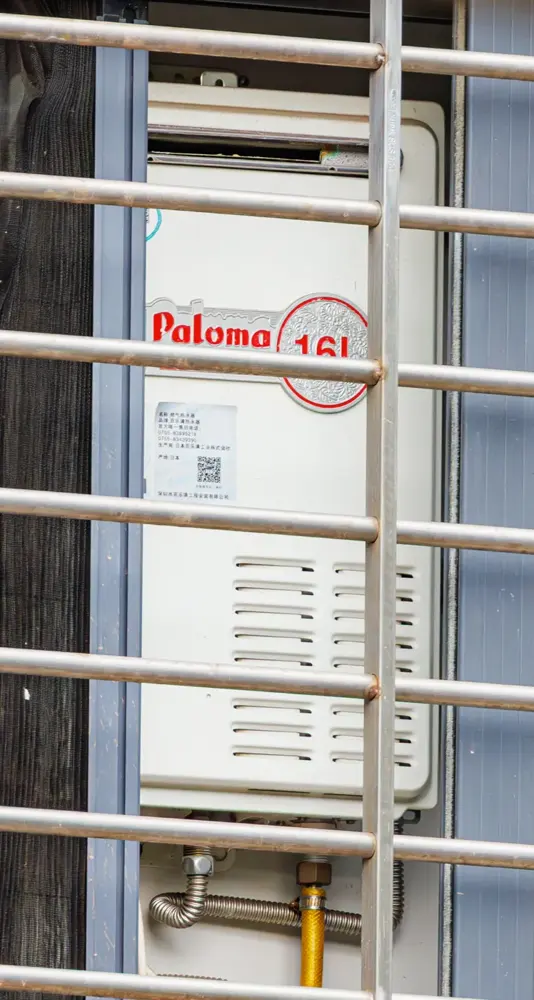
Three things separate a tankless water heater that is failing from one that only needs service: water leaking inside the cabinet, the same ignition, flame or overheat code returning after the obvious fixes, and a scaled-up heat exchanger on a unit approaching its 20-year life expectancy. Most other complaints, like lukewarm water with two showers running or an occasional reminder code, are maintenance or sizing problems. Rinnai's installation and operation manual makes the dividing line clear: it says the unit must be inspected every year by a trained and qualified professional, and a leak code means shut off the water and call a licensed professional (Rinnai RE manual). If anyone in the house has headaches, dizziness or nausea that ease when they leave, skip the diagnosis and read the carbon monoxide section first.

✓ Checked by a licensed plumber Kevin Orr, Texas Master Plumber License M-47441 (look it up)
Last reviewed
In this guide
- Service problem or failing unit?
- Start with the code on the display
- Sign 1: Water inside the cabinet
- Sign 2: Ignition and flame failures that keep returning
- Sign 3: Overheat and scale codes
- Sign 4: A yellow or unstable flame
- Sign 5: Corrosion on the cabinet
- Sign 6: Blocked air or exhaust
- Carbon monoxide: the sign you cannot see
- Things that look like failure but are not
- How old is too old?
- Repair or replace: check the warranty first
- Frequently asked questions
- Sources
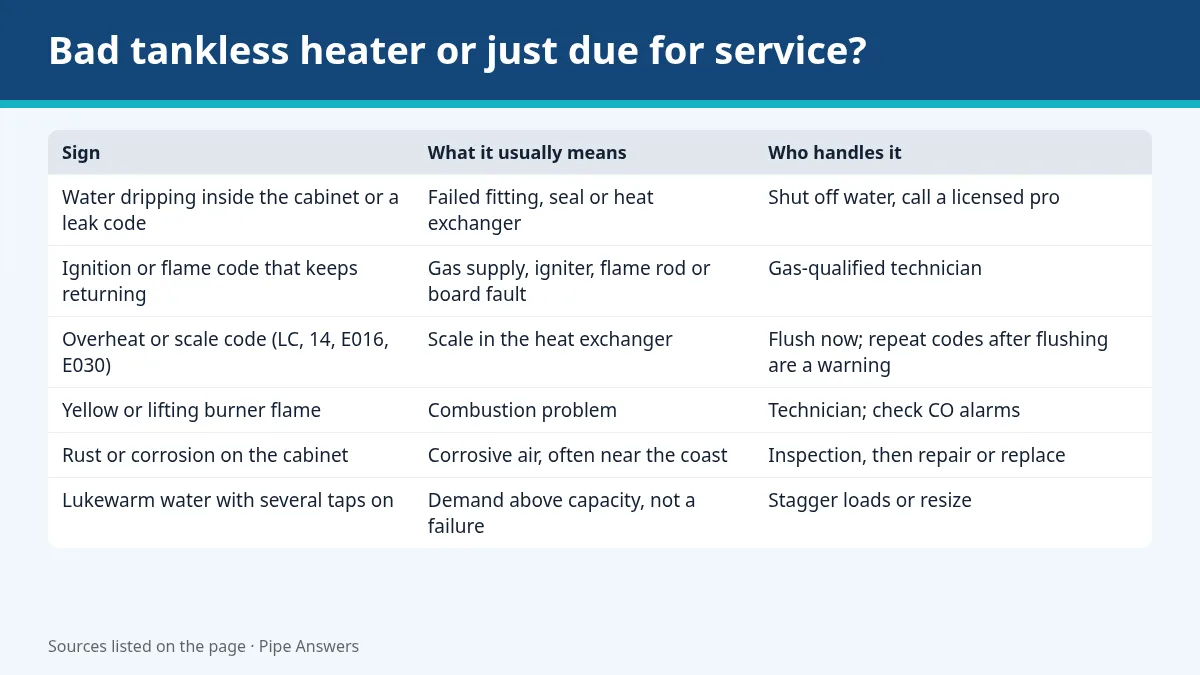 Graphic: summary of this guide, made by our team from the cited sources.
Service problem or failing unit?
| Sign | What it usually means | Who handles it |
|---|---|---|
| Water dripping inside the cabinet or a leak code | Failed fitting, seal or heat exchanger | Shut off water, call a licensed pro |
| Ignition or flame code that keeps returning | Gas supply, igniter, flame rod or board fault | Gas-qualified technician |
| Overheat or scale code (LC, 14, E016, E030) | Scale in the heat exchanger | Flush now; repeat codes after flushing are a warning |
| Yellow or lifting burner flame | Combustion problem | Technician; check CO alarms |
| Rust or corrosion on the cabinet | Corrosive air, often near the coast | Inspection, then repair or replace |
| Lukewarm water with several taps on | Demand above capacity, not a failure | Stagger loads or resize |
| SS or E760 reminder | Routine flush is due | Book service |
Start with the code on the display
Modern tankless units diagnose themselves, so the display is the best first clue. Write the code down before resetting anything, so you can tell the technician exactly what the unit reported.
| Rinnai code | Navien code | What the manual says it means |
|---|---|---|
| 11 | E003 | No ignition; check the gas supply first |
| 12 | E012 | No flame or flame loss |
| 14, 16 | E016, E030 | Thermal fuse, high outgoing temperature, heat exchanger or exhaust overheating |
| LC | E760 | Scale build-up (Rinnai) or flushing and service alarm (Navien) |
| 10 | E110 | Air supply or exhaust blockage, abnormal air pressure |
| 32, 33 | E407 | Water temperature sensor (thermistor) fault |
| 70 | E515 | Control board fault |
| 79 | none in this table | Water leak detected |
Sources for the table: the Rinnai RE manual and the error code chart in Navien's NPE-2 user manual (Navien NPE-2 manual). Codes differ by model and generation, so confirm against the manual for your exact unit.
A single code after a power cut or a gas outage is not a verdict. The same code coming back week after week, after the owner-level checks in the manual have been done, is.
Sign 1: Water inside the cabinet
A tankless heater should be dry inside. Drips from the bottom of the cabinet, mineral crust around fittings or a puddle under the unit mean something under pressure is leaking. Rinnai's code 79, water leak detected, comes with a single instruction: turn off the water supply and contact a licensed professional. A loose fitting or a seal is a modest repair. A leak from the heat exchanger itself is the kind that pushes an older unit toward replacement.
Make sure the water is really coming from the heater. Water from a relief valve discharge pipe is a different problem, covered in our guide to a water heater relief valve that keeps dripping.
Sign 2: Ignition and flame failures that keep returning
When the burner will not light or loses its flame, the manuals start with the cheap causes. Navien's first action for E003, ignition failure, is to make sure the main gas supply valve is open. Rinnai's list for code 11, no ignition, begins with checking that gas is on at the heater, the meter or the propane cylinder and that a propane tank actually has gas in it. Further down, the same lists move into the parts that wear out: the igniter, the flame rod and its carbon build-up, the gas solenoid valves and the control board.
So the pattern to watch for is this: gas confirmed on, unit reset, and the code still returns. That is a component fault. Usually it is fixable, but it is a job for a technician with the model's diagnostic data, not for trial and error.
Sign 3: Overheat and scale codes
Scale is the main long-term threat to a tankless heat exchanger in hard water. The Building America Solution Center says scale building up in heat exchangers, especially in hard water areas, reduces capacity and efficiency and in extreme situations can cause complete water heater failure (Building America Solution Center). The codes give advance warning. On Rinnai units, LC means scale in the heat exchanger that must be flushed to prevent damage, and the code 14 checklist includes hot spots on the heat exchanger that may be caused by scale. Navien's actions for E016, heat exchanger overheating, and E030, exhaust overheating (the unit shuts down when the flue passes 149°F), both include flushing the heat exchanger.
A flush that clears the code buys time. A unit that throws overheat codes again soon after a proper flush, or keeps running lukewarm afterward, may have scale damage that flushing cannot reverse. Navien itself calls flushing "a somewhat complicated procedure" and warns that improper maintenance can void the warranty, so book a professional if you have not done one before.
Sign 4: A yellow or unstable flame
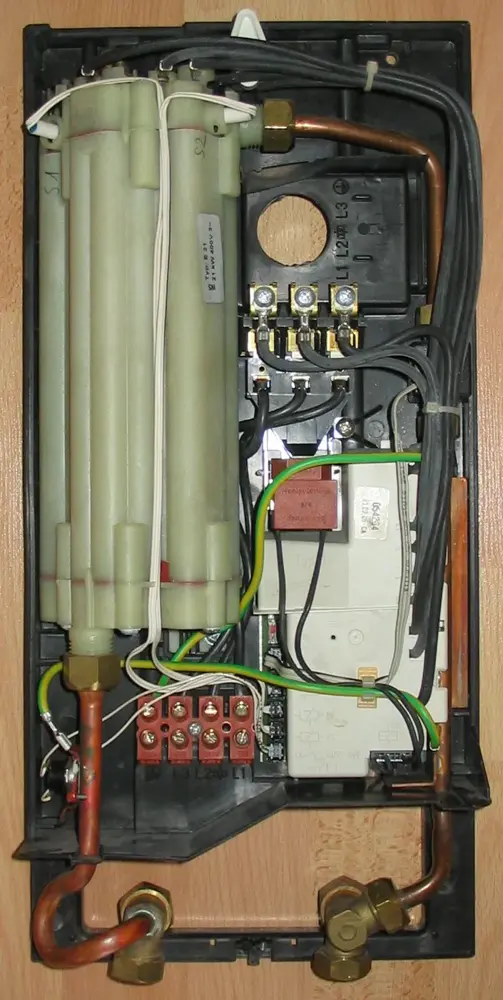
On a gas unit, the flame is a health check. Rinnai's maintenance section says the burner must burn with a clear, blue, stable flame that covers the burner surface, and it shows a yellow flame as unsatisfactory. Viewing the flame means taking off the front panel, and the manual assigns repairs and maintenance to a trained and qualified professional, so this is something to ask about at the annual service rather than open up yourself. A technician who reports a yellow flame has found a combustion problem that needs fixing before the unit runs normally again.
Sign 5: Corrosion on the cabinet
Outdoor and coastal units take a beating. Rinnai notes that installations in or near coastal areas may need extra maintenance because of corrosive airborne salt, and that if corrosion is observed on the body of the water heater, it should be inspected to ensure proper operation and, if necessary, repaired or replaced. Pay closest attention to rust around the vent, the gas connection and the water fittings.
Sign 6: Blocked air or exhaust
Venting codes such as Rinnai's 10 (air supply or exhaust blockage) and Navien's E110 (abnormal air pressure) often have simple causes. Navien's actions are to make sure the exhaust pipe is free of obstructions and to clean the intake air filter, and Rinnai tells owners to keep the area around the flue terminal clear of snow and ice. If a clear vent and a clean filter do not stop the code, the fan or the vent installation needs a technician.
Carbon monoxide: the sign you cannot see
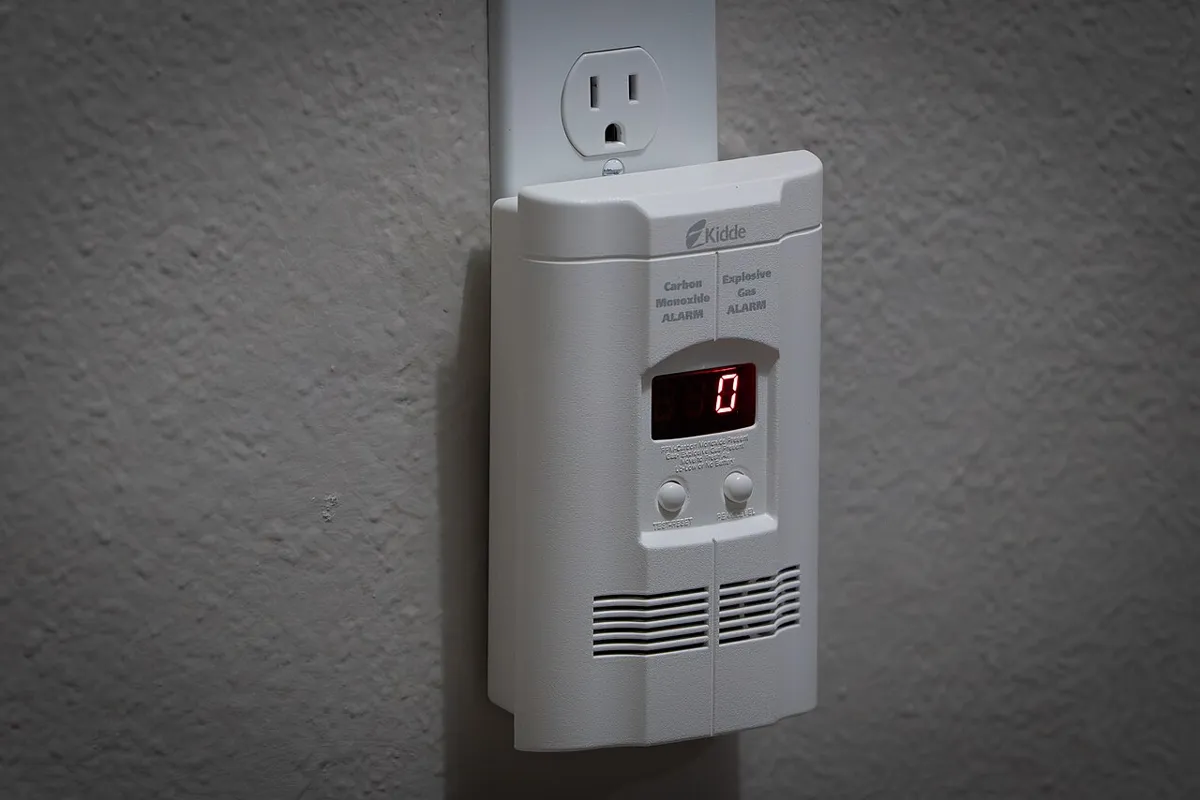
A gas tankless heater with a combustion or venting fault can produce carbon monoxide, which the CDC describes as an odorless, colorless gas, with no warning sign on the unit itself. The U.S. Consumer Product Safety Commission says about 170 people in the United States die every year from CO produced by non-automotive consumer products, including malfunctioning water heaters, and that early CO poisoning feels like the flu without the fever: headache, fatigue, shortness of breath, nausea and dizziness (CPSC). If you have those symptoms, CPSC says to get outside to fresh air immediately and call the fire department from a neighbor's home.
For prevention, CPSC recommends CO alarms that meet the UL 2034 standard, and the CDC advises having the water heater and other gas appliances serviced by a qualified technician every year and replacing CO detectors per the manufacturer's instructions or every 5 years (CDC).
Things that look like failure but are not
- Lukewarm water when two or three fixtures run. That is usually capacity or winter inlet temperature. Our guide on why a tankless water heater runs out of hot water walks through the checks.
- A few seconds of cold mid-shower. The cold water sandwich effect after the tap is turned off and on again is a known trait of tankless units.
- No hot water from a trickle. Each unit has a minimum flow that fires the burner; Navien's checklist asks whether the tap draws at least 0.5 gallons per minute.
- A service reminder. Rinnai's SS and Navien's E760 mean a flush is due, not that the unit is failing.
How old is too old?
ENERGY STAR's demand water heater bulletin puts the life expectancy of these units at 20 years, much longer than conventional storage heaters (ENERGY STAR), and the Solution Center gives up to 20 years for tankless against 10 to 15 for tank-type heaters. That is a ceiling for a well-kept unit, not a promise; hard water and missed flushes pull it down.
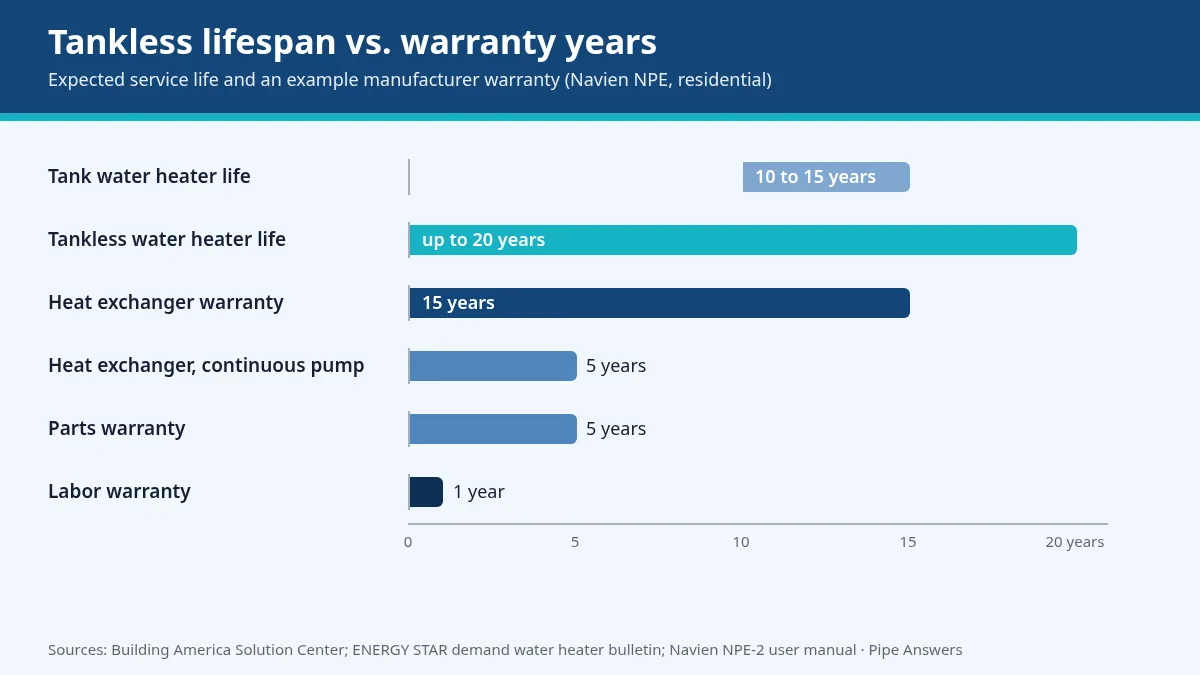 Graphic: made by our team from the Building America Solution Center, ENERGY STAR and the Navien NPE-2 user manual warranty table.
Your installation invoice is the best record of age, and it matters for repairs: Navien's warranty periods run from the date of original installation, and Navien can ask for proof of that date. If you are not sure what kind of heater you have, our guide on how to tell if you have a tankless water heater shows what to look for.
Repair or replace: check the warranty first
The warranty often decides the math. Navien's residential NPE warranty runs 1 year on labor, 5 years on parts and 15 years on the heat exchanger for standard or controlled recirculation installs, dropping to 3 years on parts and 5 on the heat exchanger when an external pump circulates continuously. The exclusions matter as much as the years. Navien's list includes damage from hard water deposits and lime or mineral build-up, gas flow problems, failure to perform regular maintenance, installation by a non-licensed installer and products bought through the internet. Rinnai's manual says heat exchanger replacement due to water quality damage, lime build-up damage and freeze damage are not covered.
A practical way to decide:
- Heat exchanger sound, single failed part. Repair. A fault traced to a sensor, flame rod, igniter or control board is a single-part repair.
- Heat exchanger still under warranty. Call the original installer first; Navien routes warranty claims through the installer and asks for proof of purchase.
- Heat exchanger leaking or scaled out, out of warranty, unit approaching 20 years. Replacement is usually the better use of money, and it is the moment to fix whatever caused the scale, such as water treatment and a flushing schedule.
- Any combustion or CO concern. Shut the unit down until a qualified technician has checked it, whatever its age.
Frequently asked questions
How long should a tankless water heater last?
ENERGY STAR gives demand (tankless) water heaters a life expectancy of 20 years, and the Building America Solution Center says they are generally considered to last up to 20 years, against 10 to 15 years for tank models. Hard water and skipped flushing shorten that.
Can a tankless water heater be repaired instead of replaced?
Usually, if the heat exchanger is sound. Rinnai's and Navien's troubleshooting tables trace many faults to individual parts such as sensors, flame rods, igniters, fans and control boards. A leaking or scale-damaged heat exchanger on an older unit is the repair most likely to make replacement the better buy.
Does the warranty cover a heat exchanger ruined by hard water?
Often not. Navien's warranty excludes damage from hard water deposits and lime or mineral build-up, and Rinnai's manual says heat exchanger replacement due to water quality is not covered. Keep flushing records.
What does a blinking error code mean if the water is still hot?
Some codes are reminders rather than faults. Rinnai's SS and Navien's E760 both mean it is time for routine service and flushing. Write the code down and look it up in your manual before calling.
Should I worry about carbon monoxide from a tankless water heater?
Any gas-burning water heater can produce carbon monoxide if it malfunctions or the vent is blocked. The CDC advises having gas water heaters serviced by a qualified technician every year and keeping CO detectors near every sleeping area.
Smell gas? Leave the building without switching anything on or off, then call your gas utility or 911 from outside.
Know your shutoff. Find your home’s main water shutoff before you need it. Most fixtures also have their own small valve.
Sources
- RE Series Installation and Operation Manual, Rinnai
- NPE-2 User's Information Manual, Navien
- Gas-Fired Tankless Water Heaters, Building America Solution Center (PNNL, U.S. DOE)
- Technical Bulletin: ENERGY STAR Demand Water Heaters, ENERGY STAR (U.S. EPA)
- Carbon Monoxide Questions and Answers, U.S. Consumer Product Safety Commission
- About Carbon Monoxide Poisoning, U.S. Centers for Disease Control and Prevention
Spotted an error? See our corrections policy or email contact@pipeanswers.com.

Pipe Answers Editorial Team
Our editors build each guide from the sources listed above and check every claim and number against them before publishing. How the team works
Kevin Orr
Expert Reviewer, Plumbing
Texas Master Plumber License, M-47441 · Verify license
Kevin Orr is a Texas Master Plumber, a U.S. Army veteran and the owner of a plumbing company. In his view, good plumbing is more than fixing pipes. It means showing up when you say you will, explaining what needs to…
Related guides
-
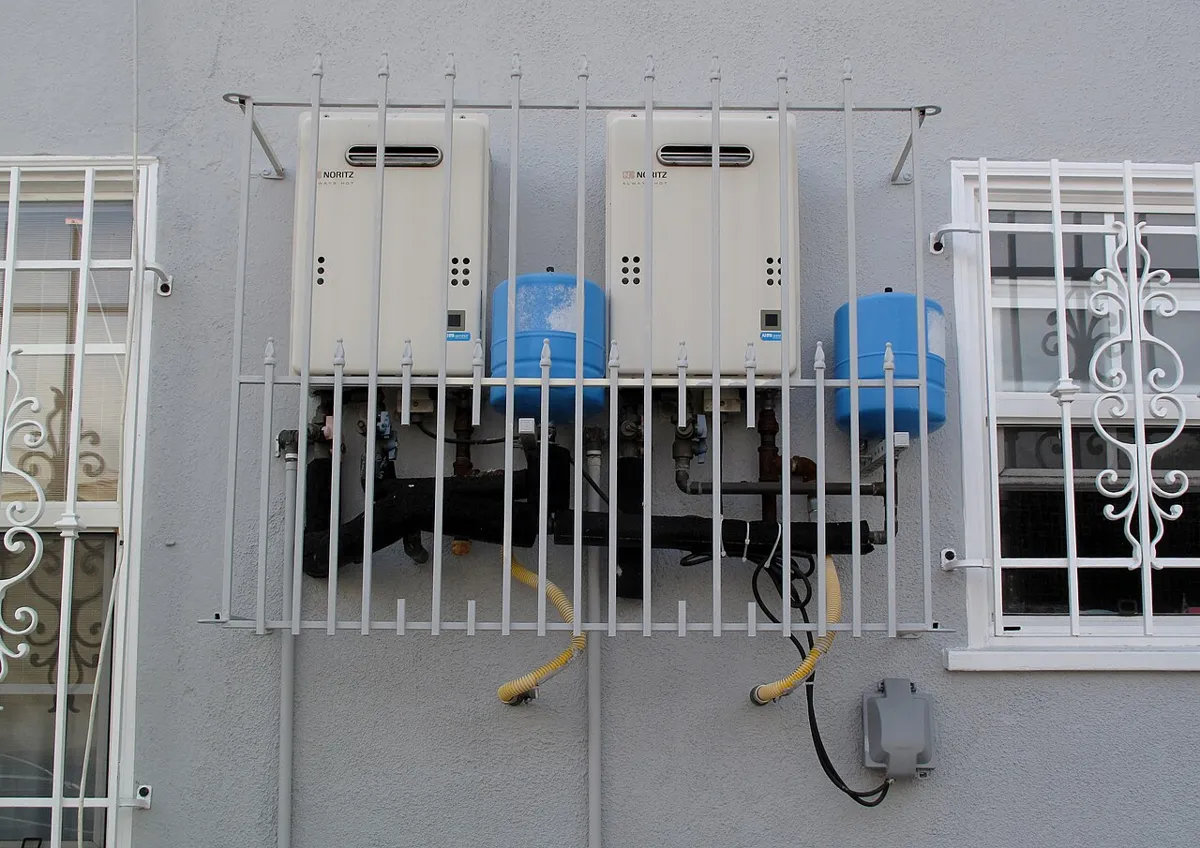 Water Heaters
Why Is My Tankless Water Heater Running Out of Hot Water?
A tankless heater has no tank to empty. Hot water fades when demand beats its gallons per minute, winter inlet water is colder, or a filter, scale or gas line is choking it.
-
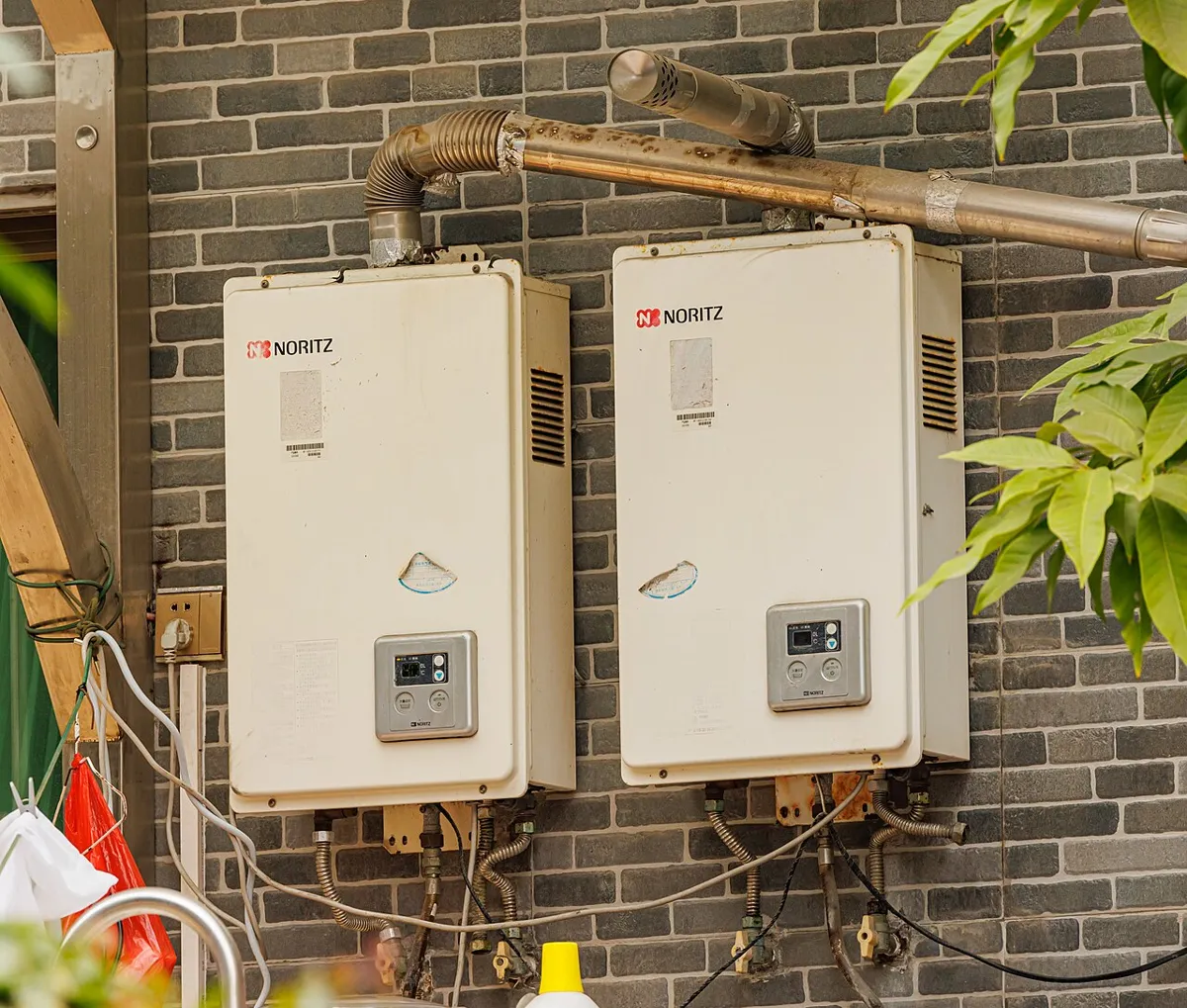 Water Heaters
How Do I Know If I Have a Tankless Water Heater?
A tankless water heater is a box about the size of a carry-on suitcase mounted on a wall, not a tall tank on the floor. Five checks, including how to read the EnergyGuide label.
-
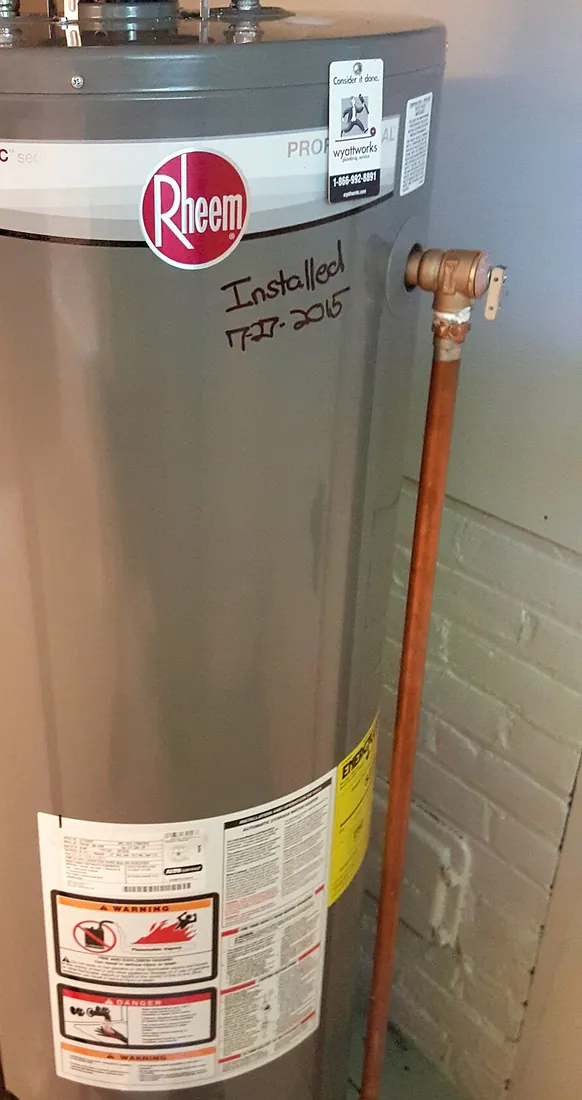 Water Heaters
Water Heater Relief Valve Dripping? What It Means and How to Fix It
A dripping T&P relief valve means pressure, temperature or a worn valve. Learn the thermal expansion test, the code pressure limits, the fixes, and why you never cap the pipe.
-
 Water Heaters
Why Does My Shower Turn Cold After 5 Minutes?
Hot water that runs out after a few minutes usually means a failed lower element or dip tube in a tank heater, too much demand, or, with tankless, flow dropping below the burner's minimum. How to narrow it down.