Toilet Leaking at the Base? How to Find the Source and Fix It
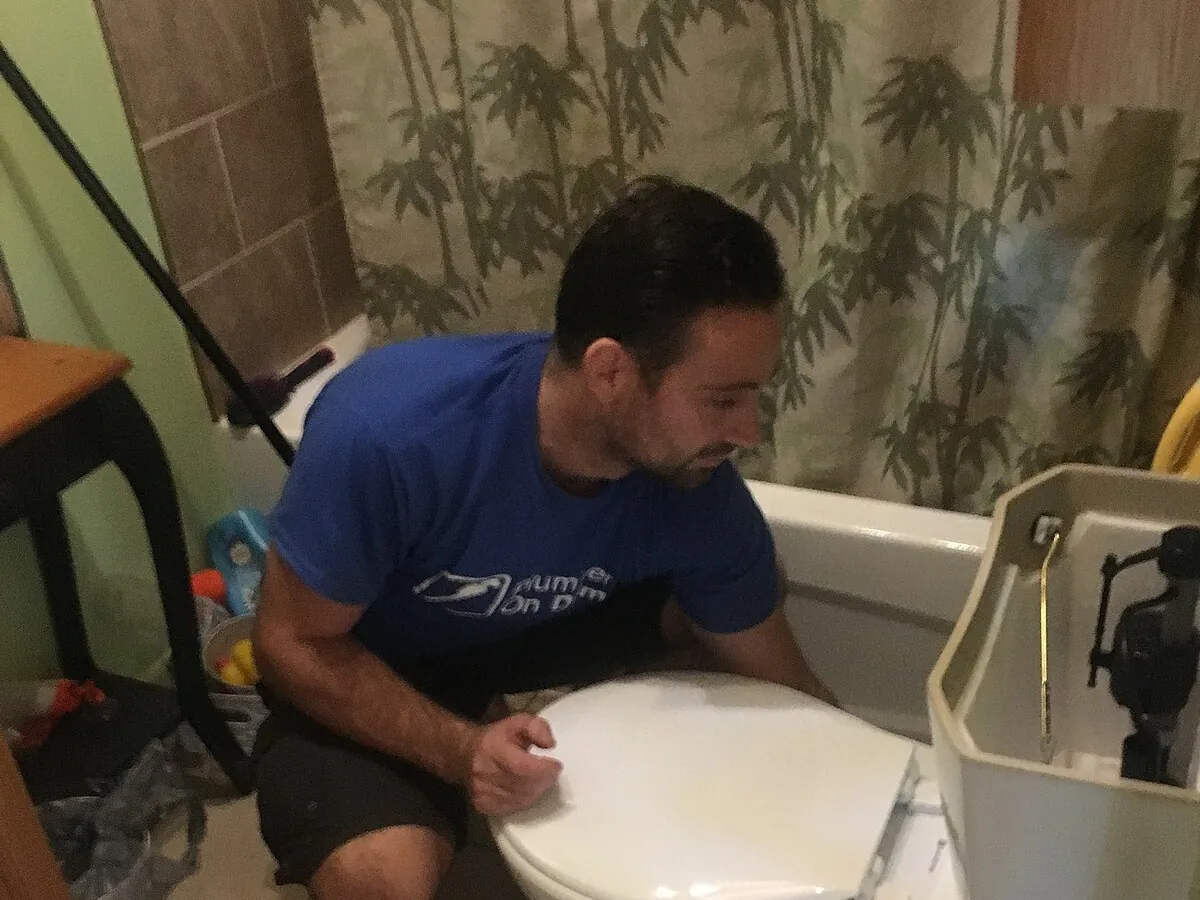
Water around the base of a toilet comes from one of four places: condensation running down the outside of the tank, a leaking supply line or shutoff valve, a toilet that has worked loose, or a failed wax ring under the toilet. Only the last one is a true "base" leak, and it is also the only one that cannot be fixed with the toilet in place. Dry everything, find which of the four it is, then fix that.

✓ Checked by a licensed plumber Kevin Orr, Texas Master Plumber License M-47441 (look it up)
Last reviewed
In this guide
- Where is the water coming from?
- Step 1: Rule out sweat
- Step 2: Check the supply line and shutoff valve
- Step 3: Check whether the toilet rocks
- Step 4: Can you fix a wax ring without removing the toilet?
- How to replace a toilet wax ring
- Flange height and new flooring
- Check the floor and the ceiling below
- When to call a plumber
- Frequently asked questions
- Sources
Do not leave it. A failed seal can also let sewer gas into the room, and the EPA's guide to mold, moisture and your home says to dry water-damaged areas and items within 24 to 48 hours to prevent mold growth.
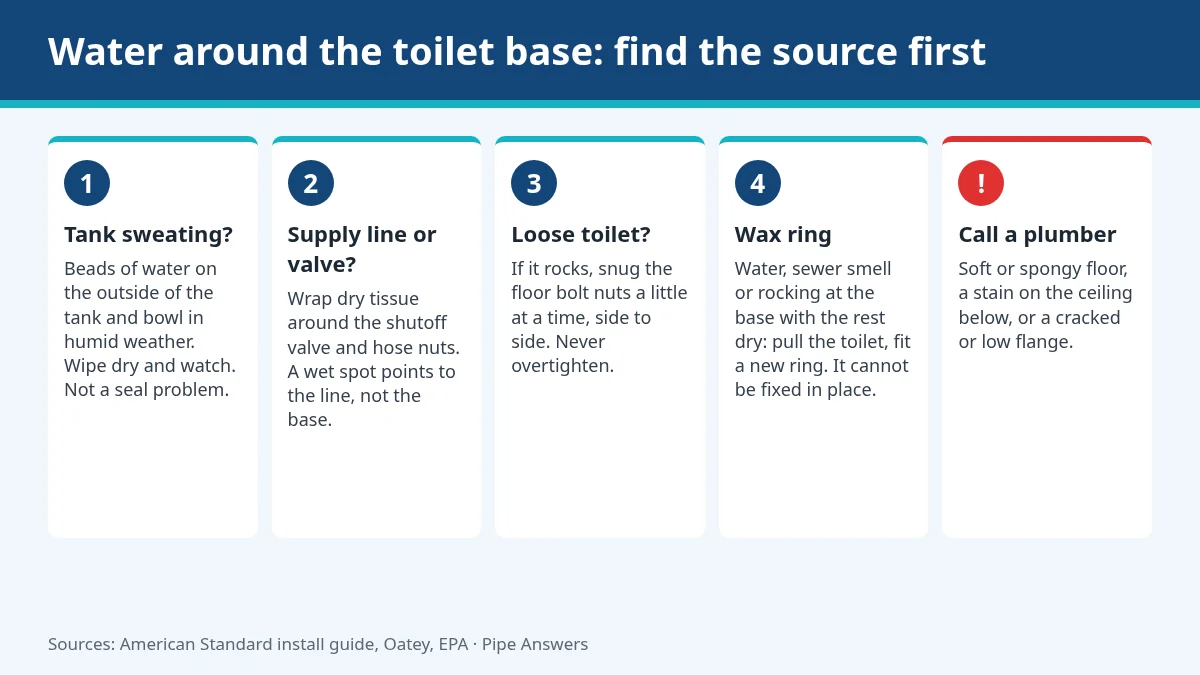 Graphic: summary of this guide, made by our team from the cited sources.
Where is the water coming from?
Dry the tank, bowl, supply line and floor with a towel, then check back after the toilet has sat, and again right after a flush.
| What you see | Likely source | What to do |
|---|---|---|
| Beads of water all over the outside of the tank, worse on humid days | Condensation (sweating) | Lower bathroom humidity; not a seal problem |
| Wet shutoff valve, supply hose or the nut under the tank | Supply line or valve | Tighten or replace the line or valve |
| Toilet rocks when you sit or push on it | Loose closet bolts, or a broken flange | Snug the bolts evenly; check the flange |
| Water seeps out from under the base, often after a flush, with the tank and line dry | Failed wax ring | Pull the toilet and replace the ring |
| Sewer smell near the base | Failed wax ring | Pull the toilet and replace the ring |
| Stain on the ceiling below the bathroom | Leak at the seal or flange reaching the floor below | Stop using the toilet and call a plumber |
Sources: wax ring failure signs (water around the base, rocking, bad smells) and ceiling stains from Oatey; condensation from the EPA. The "dry it and watch where it returns" check is our method.
Step 1: Rule out sweat
A tank full of cold water sweats in a humid bathroom, and the drips run down to the floor and pool at the base. That looks like a base leak but is not one. The EPA says condensation on pipes and other surfaces can be a sign of high humidity, and recommends keeping indoor humidity below 60 percent, ideally between 30 and 50 percent. If the outside of the tank is wet all over, read our guide on why a toilet tank sweats and how to stop it before you pull anything apart.
Step 2: Check the supply line and shutoff valve
Wrap a dry tissue or paper towel around the shutoff valve, the hose nuts at both ends and the nut under the tank. Wait, then look for a wet spot. A drip that runs along the hose can end up at the base and fool you.
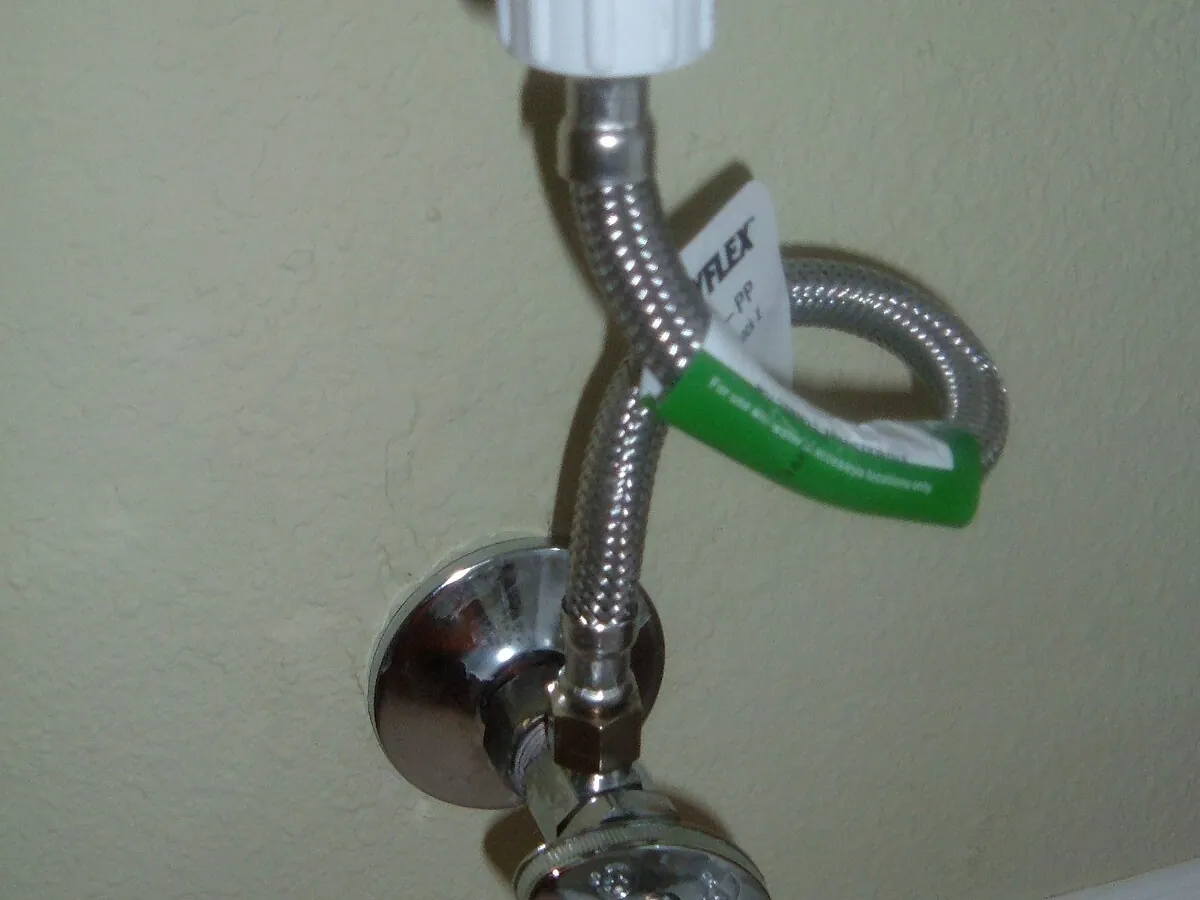
On a two-piece toilet, also feel under the tank where the tank bolts pass through into the bowl. A drip from those bolts runs down the back of the bowl and can look like a base leak; the fix there is new tank bolts and washers, not a wax ring.
If you find the drip at the valve or hose, the fix is the line or the valve, not the toilet. When you reconnect a supply line, American Standard's install guide says not to use plumber's putty on those fittings.
While you are at the toilet, do a quick tank test too. EPA WaterSense's leak-checking guide says to put a few drops of food coloring in the tank; if any color shows in the bowl after 10 minutes, the tank is leaking into the bowl. That leak stays inside the toilet and will not wet the floor, but it wastes water and is worth fixing while the water is off. If the tank also drops by itself, see our guide on why a toilet's water level drops by itself.
Step 3: Check whether the toilet rocks
Push the bowl gently from side to side. A toilet that rocks can break the wax seal every time someone sits down.
- Bolt nuts are loose: snug the nuts on the closet bolts a little at a time, alternating sides. The Fluidmaster 7514 wax ring kit instructions say to tighten carefully to prevent breaking the bowl, and the American Standard guide says in capitals: do not overtighten nuts.
- It still rocks once the nuts are snug: Oatey says that if one side of the base lifts off the floor, even slightly, you likely have a cracked or broken toilet flange. Tightening harder will not fix that and can crack the porcelain.
If the toilet rocked for a while before you caught it, the ring has probably been squashed out of shape already. Snugging the bolts stops the rocking but does not rebuild the seal, so if water still appears at the base, the ring needs replacing.
Step 4: Can you fix a wax ring without removing the toilet?
No. The wax ring is the gasket between the toilet's outlet (the horn) and the floor flange. The Oatey guide to replacing a toilet wax ring describes it as forming a watertight and airtight seal that keeps leaks and sewer gas in, and its repair steps start with taking the toilet off the floor. There is no way to reach the ring with the toilet in place.
Caulk is not a shortcut. American Standard's install guide does call for a bead of sealant around the base on a new install, but that bead is a finish, not the seal. Caulking over a failed ring can hide the leak while water keeps soaking the subfloor.
How to replace a toilet wax ring
This is a common DIY repair, and Oatey rates it intermediate and under 2 hours. You need a new wax ring, new closet bolts (Oatey says to replace the T-bolts whenever you replace a wax ring), a putty knife, wrenches, a sponge, a bucket and gloves. A new supply line is cheap insurance while it is off.
- Shut off and drain. Turn the shutoff valve clockwise, flush to empty the tank and bowl, and sponge out what is left. Oatey suggests a bucket or towel under the valve to catch drips.
- Disconnect and lift. Loosen the supply line nut, pop off the bolt caps, and remove the nuts. Rock the toilet gently to break the old seal and lift it straight up onto padding. Toilets are heavy, so get help.
- Scrape and inspect. Scrape all old wax from the flange and the toilet horn. Look at the flange for cracks, rust or damage. American Standard says the mounting surface must be clean and level before the toilet goes back.
- Set the new ring. Center the ring on the flange (or press it onto the bowl outlet, as the Fluidmaster kit instructions show). Fluidmaster says the wax should be at least 70°F to flow properly, so do not use a ring straight out of a cold garage. Never stack two rings; Oatey says to use an extra-thick ring or a flange extender if the flange sits below the floor.
- Lower and seat. Lower the toilet straight down over the bolts. American Standard says to press the bowl down fully on the wax ring and flange, then alternately tighten the nuts until the toilet is firmly seated. Do not overtighten.
- Reconnect and test. Reattach the supply line, turn the water on, flush several times and check the base and the floor below for leaks.
Flange height and new flooring
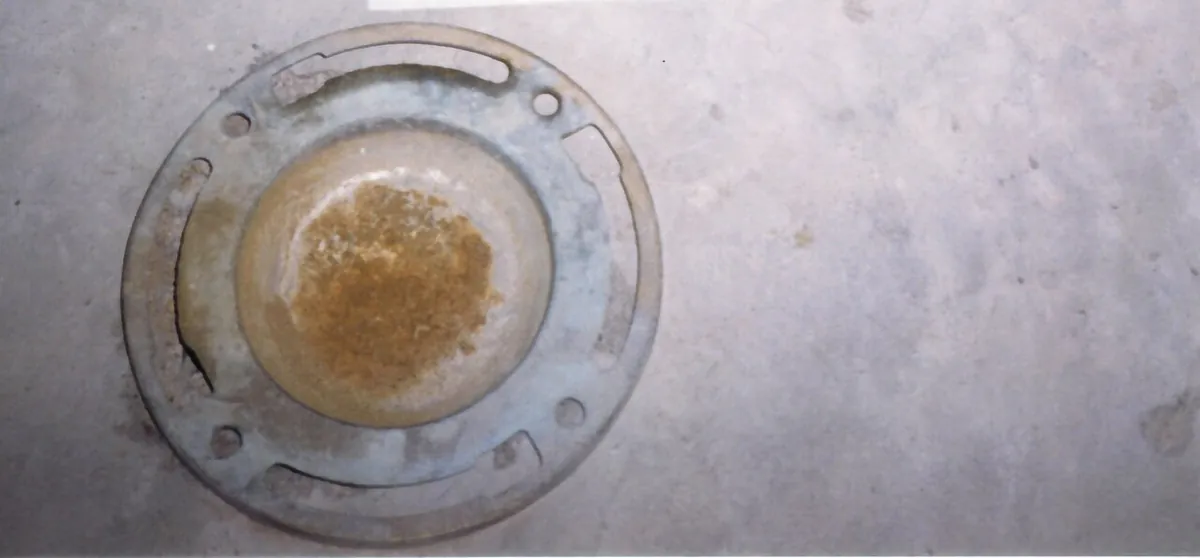
A wax ring only seals if the flange sits at the right height. Oatey says the flange must sit flush with or slightly above the finished floor. If you put in thicker flooring, such as tile over old vinyl, the flange can end up below the new floor and the ring cannot compress properly. Oatey's fix is a flange spacer, an extra-thick ring or a flange extender, never two stacked rings.
The code side is simple: the 2024 IRC section P2705.1 on fixture installation says floor-outlet fixtures shall be secured to the drainage connection and to the floor with screws, bolts, washers, nuts and similar fasteners. A toilet that moves on its flange does not meet that.
Check the floor and the ceiling below
Oatey says that if you are replacing the ring because of a leak at the base or water stains on the ceiling below, find the root cause first, because a compromised subfloor can weaken the fasteners holding the flange in place. Water-damaged subfloor may need to be cut out and replaced before the toilet goes back. While the toilet is off, press around the flange: soft or spongy wood is a warning sign.
When to call a plumber
- The floor around the toilet is soft or spongy, or there is a stain on the ceiling below.
- The flange is cracked, broken, rusted through or well below the finished floor.
- The toilet still rocks after the bolt nuts are snug.
- Water still shows up at the base after a new wax ring.
- You cannot lift the toilet safely on your own.
Frequently asked questions
Can you fix a wax ring leak without removing the toilet?
No. The wax ring sits between the toilet's outlet and the floor flange, so the only way to replace it is to lift the toilet. Oatey's steps start with shutting off the water, removing the toilet and scraping off the old wax. Caulk around the outside of the base does not reseal the ring.
Should I caulk around the toilet base to stop the leak?
Caulk is not a fix for a leaking seal. American Standard's install guide does call for a bead of sealant around the base on a new install, but the seal against water and sewer gas is the wax ring underneath. If water is coming from under the toilet, the ring or flange needs attention.
Why does my toilet only leak at the base when I flush?
Each flush sends water through the outlet and past the wax ring. If the ring has failed, that is when water can escape onto the floor. Oatey lists water around the base, a rocking toilet and bad smells as signs of a failed wax ring.
Can I stack two wax rings if the flange is low?
No. Oatey says never stack wax rings. If the flange sits below the finished floor, use an extra-thick wax ring or a flange extender instead.
How fast do I need to deal with water around a toilet?
Soon. The EPA says to dry water-damaged areas and items within 24 to 48 hours to prevent mold growth, so wipe up, find the source and fix it rather than leaving a towel down for weeks.
Smell gas? Leave the building without switching anything on or off, then call your gas utility or 911 from outside.
Know your shutoff. Find your home’s main water shutoff before you need it. Most fixtures also have their own small valve.
Sources
- How to Replace a Toilet Wax Ring to Fix Toilet Leaks, Oatey
- Lexington 1.6 GPF One-Piece Toilet 2037.100 Installation Instructions, American Standard
- 7514 Reinforced Extra Thick Wax Ring Kit Installation Instructions, Fluidmaster
- Fix a Leak Week: Checking for Leaks, EPA WaterSense
- A Brief Guide to Mold, Moisture and Your Home, U.S. Environmental Protection Agency
- 2024 International Residential Code, Chapter 27 Plumbing Fixtures, Section P2705.1 (Mississippi adoption, UpCodes)
Spotted an error? See our corrections policy or email contact@pipeanswers.com.

Pipe Answers Editorial Team
Our editors build each guide from the sources listed above and check every claim and number against them before publishing. How the team works
Kevin Orr
Expert Reviewer, Plumbing
Texas Master Plumber License, M-47441 · Verify license
Kevin Orr is a Texas Master Plumber, a U.S. Army veteran and the owner of a plumbing company. In his view, good plumbing is more than fixing pipes. It means showing up when you say you will, explaining what needs to…
Related guides
-
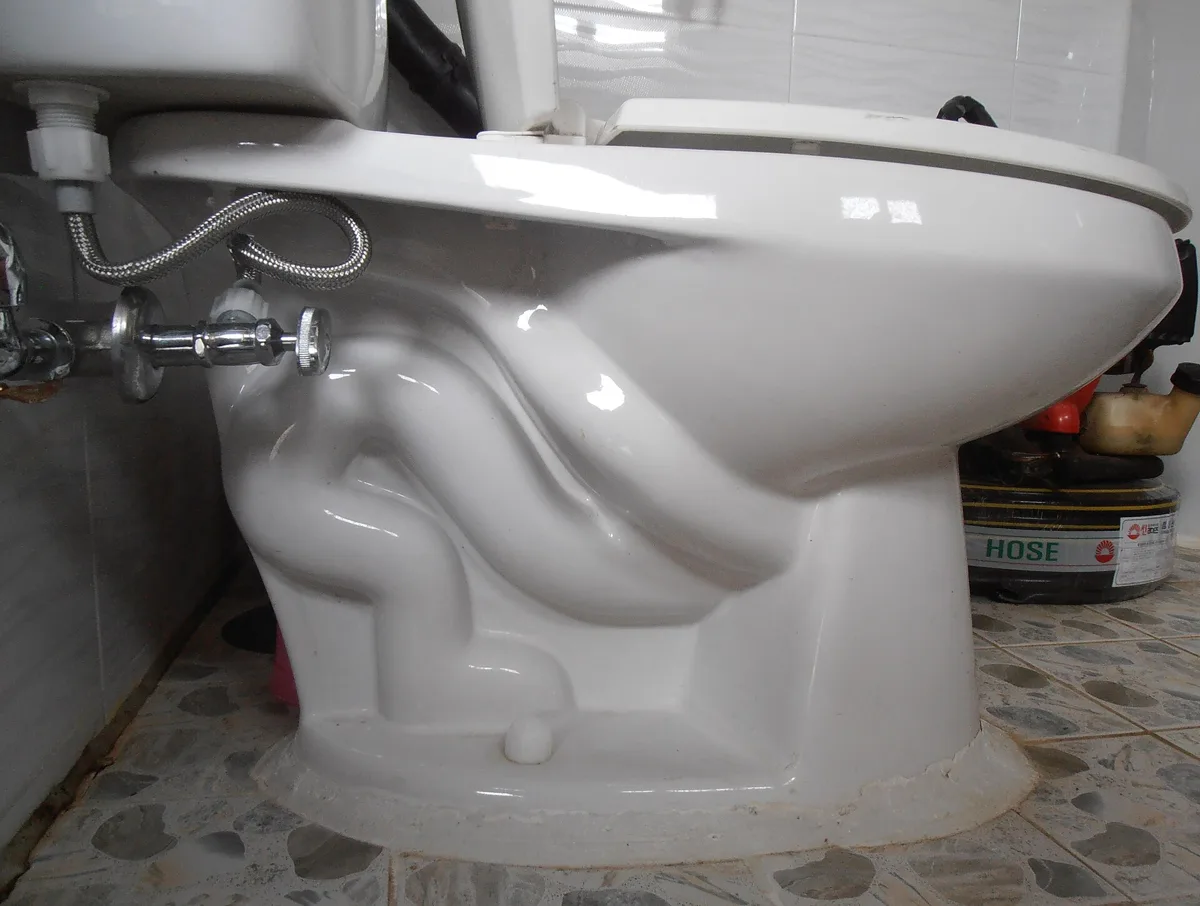 Toilets
Why Is My Toilet Tank Sweating? Causes and How to Stop It
A sweating toilet tank is condensation: humid bathroom air meets a tank full of cold water. How to tell sweat from a leak, and the fixes that work, from a fan to an anti-sweat valve.
-
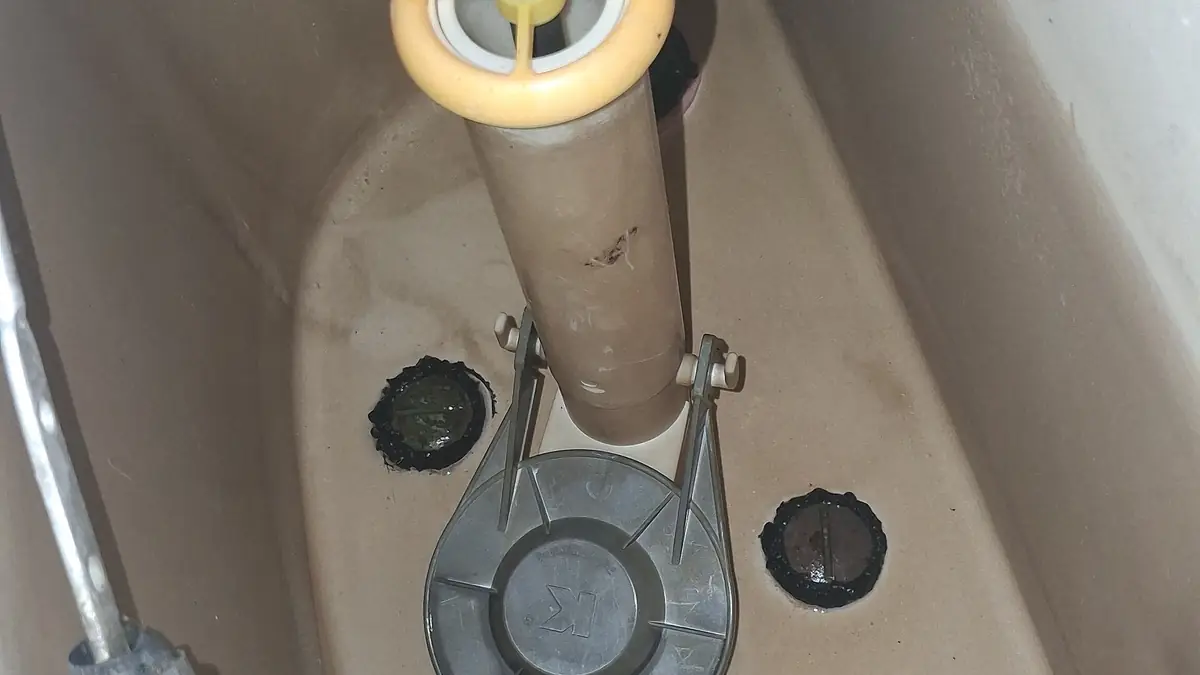 Toilets
How to Adjust the Water Level in a Toilet Tank
Set the tank water about 1/2 inch below the top of the overflow tube, or to the mark on your fill valve. How to adjust a float-ball arm, a float cup, and newer fill valves.
-
 Toilets
Why Does My Toilet Fill So Slowly? How to Speed It Up
A toilet tank that takes minutes to refill usually has a partly closed supply valve, a kinked or clogged supply line, or a fill valve clogged with sediment. How to find which and fix it.
-
 Toilets
Why Is My Toilet Fill Valve Whistling? Causes and Fixes
A whistling or squealing toilet is usually water forced through a worn or clogged fill valve. Check the supply valve first, then replace the fill valve. What each toilet noise means.