Water Under the Kitchen Sink but No Leak? Find the Source by Timing
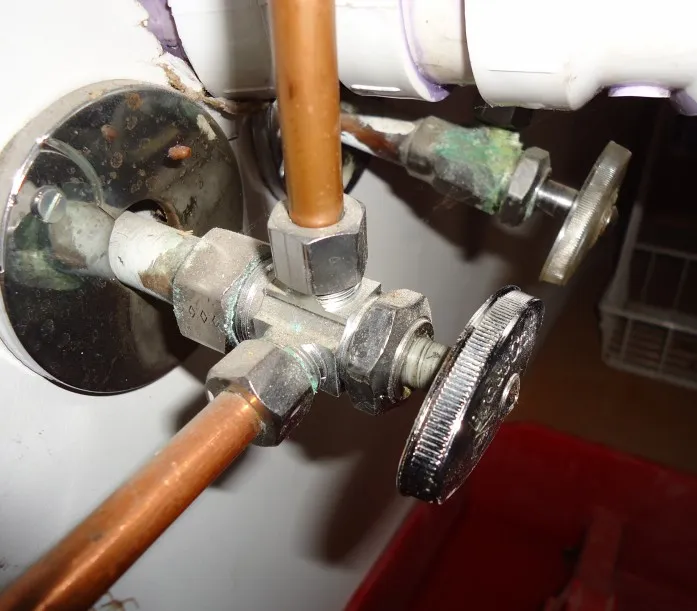
There is always a leak. It just isn't where you are looking. Water under a kitchen sink usually comes from a joint that only drips under certain conditions, a hose that leaks only while it is moving, or water that runs along a pipe before it falls. The fastest way to find it is to notice when the cabinet gets wet, then test that one condition. InSinkErator's leak guide uses the same method. If you still find nothing, it tells you to check water filters, the dish sprayer, the faucet, the dishwasher drain hose, and the seam between sink and countertop.

✓ Checked by a licensed plumber Kevin Orr, Texas Master Plumber License M-47441 (look it up)
Last reviewed
In this guide
- When the water shows up points to the source
- Run the newspaper test before you buy anything
- Wet all the time: the supply side
- Wet only after the faucet runs: the hose under the deck
- Wet only after draining: the drain side
- Wet only after the dishwasher runs
- Wet after washing up: water coming from above
- Wet in summer: sweating pipes
- Dry it out, whatever the cause
- When to call a plumber
- Frequently asked questions
- Sources
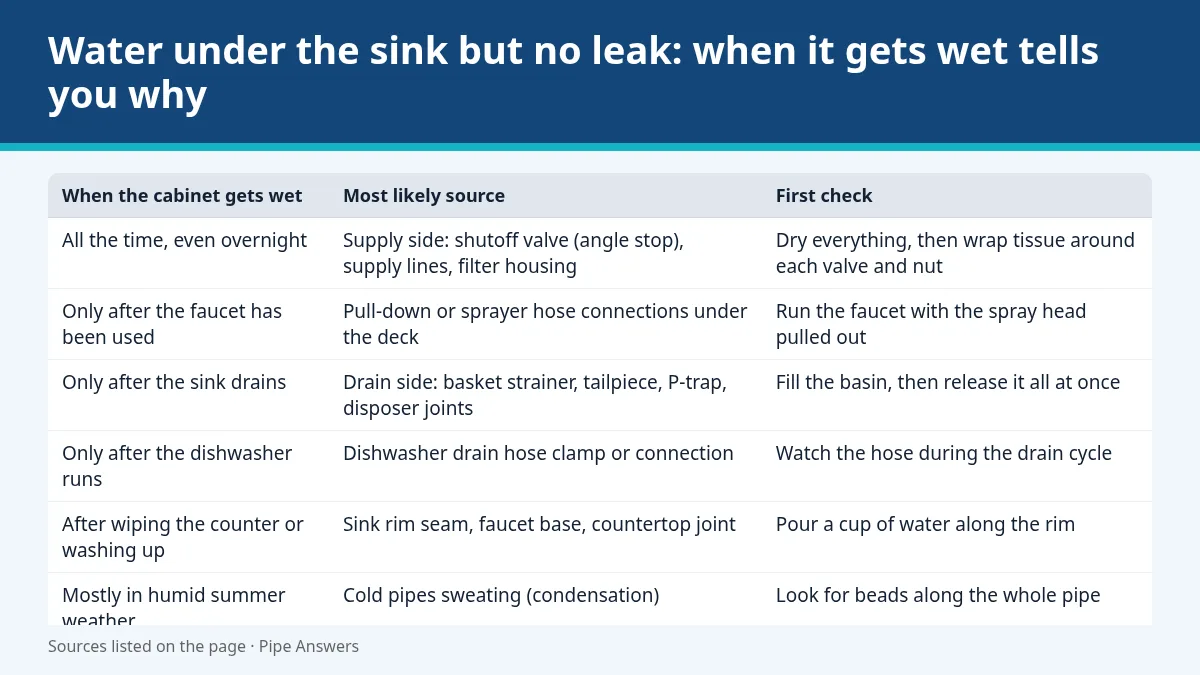 Graphic: summary of this guide, made by our team from the cited sources.
When the water shows up points to the source
| When the cabinet gets wet | Most likely source | First check |
|---|---|---|
| All the time, even overnight | Supply side: shutoff valve (angle stop), supply lines, filter housing | Dry everything, then wrap tissue around each valve and nut |
| Only after the faucet has been used | Pull-down or sprayer hose connections under the deck | Run the faucet with the spray head pulled out |
| Only after the sink drains | Drain side: basket strainer, tailpiece, P-trap, disposer joints | Fill the basin, then release it all at once |
| Only after the dishwasher runs | Dishwasher drain hose clamp or connection | Watch the hose during the drain cycle |
| After wiping the counter or washing up | Sink rim seam, faucet base, countertop joint | Pour a cup of water along the rim |
| Mostly in humid summer weather | Cold pipes sweating (condensation) | Look for beads along the whole pipe |
Moen's support article draws the first split. A faucet that leaks under the sink 24 hours a day points to the shutoff valves and supply lines. A leak that shows up only after the faucet runs points to the hose connections below the sink.
Run the newspaper test before you buy anything
This is InSinkErator's method for hard-to-find leaks. It works whether or not you have a disposer.
- Empty the cabinet and dry every pipe, nut and hose with a towel.
- Tape a sheet of newspaper flat across the cabinet floor. Any drip will leave a mark right under its source.
- Put the stoppers in, fill the sink, and leave it full for a while. A wet spot now means a basket strainer or drain flange is seeping.
- Pull the stoppers and let it drain. Drips now point to the tailpiece, slip nuts or P-trap.
- Run the faucet (and the disposer, if you have one) and look again.
- If the paper stays dry, leave it in place for a few days so a slow, intermittent source has time to show itself.
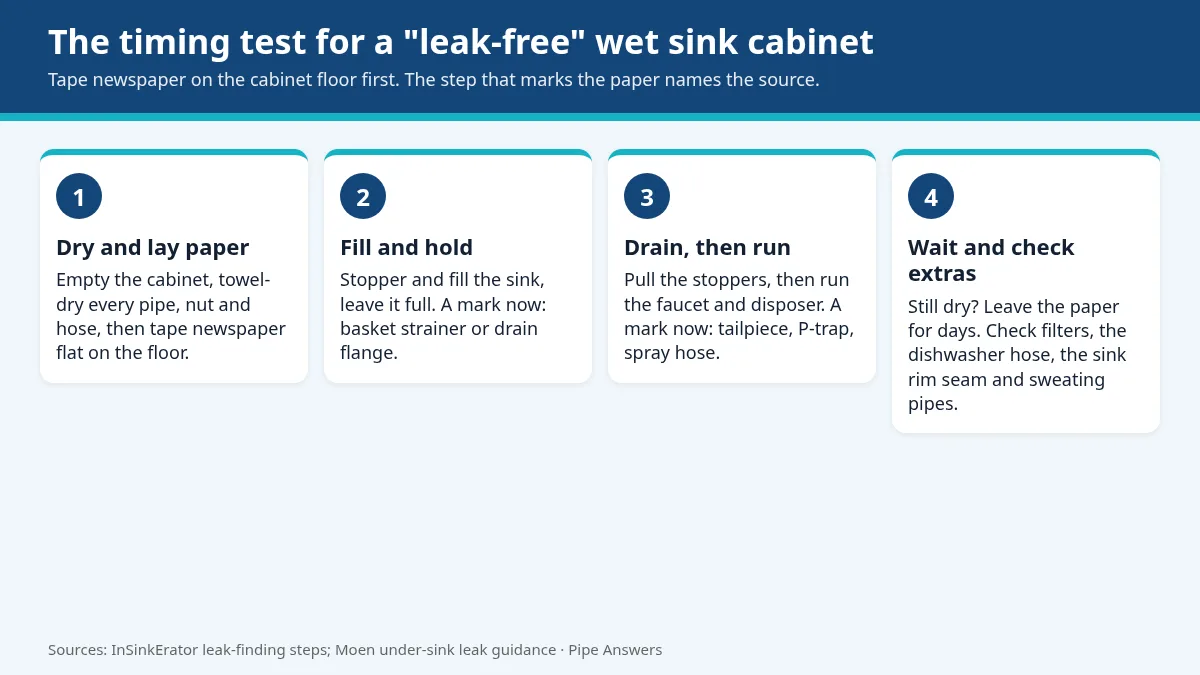 Graphic: made by our team from InSinkErator's leak-finding steps and Moen's supply-versus-hose split (linked above).
Paper beats your eyes because water travels. A drop that starts at a slip nut can run along the trap and fall well away from the joint, and that is why you "can't see the leak."
Wet all the time: the supply side
If the paper is damp even when nobody has used the sink, the leak is under pressure. Check, in this order:
- The shutoff valves (angle stops). Look for a drip at the stem behind the handle and at the nuts where the pipes enter the valve.
- The supply lines between the valves and the faucet. Feel along each line and both end nuts for moisture.
- Water filter or reverse osmosis housings under the sink, which InSinkErator also names as a hidden source.
You can confirm a pressurized leak without opening anything. EPA WaterSense suggests reading your water meter before and after a two-hour period when no water is used. If the meter moves at all, you probably have a leak somewhere in the house. It could be under this sink, a toilet or another fixture.
Wet only after the faucet runs: the hose under the deck
Pull-down and pull-out faucets have a spray hose that slides up and down through the faucet body every time you use it, with a weight and one or more quick-connect fittings below the sink. Moen says leaks that appear only after use come from that cluster of hose connections. Pull the spray head out, run water, and watch the connections with a flashlight. Moen's quick-connect instructions name two causes of a leak there: an O-ring out of its groove, or a hose pushed in at an angle instead of straight. Either one can spit water while the faucet is on and stay dry otherwise. Moen asks owners to identify the faucet model before ordering the hose parts.
Wet only after draining: the drain side
Drain joints aren't under pressure, so they only leak when water passes. A sink that drains slowly makes this worse, because water backs up against the joints. If the paper marks only during step 3 or 4, look at:
- The basket strainer nut and its gasket under each bowl.
- The slip nuts on the tailpiece and P-trap.
- The disposer's sink flange, discharge elbow and lower housing. Our guide to how to tell if your garbage disposal is bad walks through which disposer leaks are a gasket and which mean replacement.
If the sink is also slow, clear that first. See why both sides of a kitchen sink drain slowly.
Wet only after the dishwasher runs
A dishwasher pushes a lot of water through one rubber hose in a short burst, so a loose clamp may only leak during the pump-out. InSinkErator's dishwasher inlet checklist asks you to confirm the knockout plug was removed, the clamps are tight, any hose adapter is intact, and the elbow-to-trap joint is tight. The Badger 5XL manual warns that if the hose is connected without knocking out the plug, the dishwasher may overflow.
Check the height too. Whirlpool's installation instructions say to connect the drain hose above the drain trap and at least 20 inches above the floor. They recommend looping the hose up and fastening it under the counter, or using an air gap. Whirlpool's drain loop page explains that this height prevents backflow. A hose lying low in the cabinet is a sign the install was rushed, so check its clamp closely.
Wet after washing up: water coming from above
Some water never touches a pipe. If the caulk or seal around a drop-in sink has failed, water you splash on the counter seeps under the rim and runs down the inside of the cabinet. A loose faucet base does the same. InSinkErator names the sink/countertop seam and countertop joints in its list of hidden sources. To test it, dry the cabinet, then slowly pour a cup of water along the rim and around the faucet base while someone watches from below. Water that shows up on the cabinet wall, not on the pipes, confirms it.
Wet in summer: sweating pipes
Cold water pipes in a warm, humid kitchen can collect condensation, and drops run down to the cabinet floor. The EPA's mold and moisture guide treats condensation on pipes as a sign of high humidity. It suggests insulating cold water pipes, using exhaust fans while cooking and running the dishwasher, and keeping indoor humidity below 60 percent, ideally 30 to 50 percent. Sweating looks different from a leak. The whole cold pipe is beaded, the hot pipe is dry, and the fittings aren't wetter than the straight runs. Toilets do the same thing in humid weather, as our guide to a sweating toilet tank explains.
Dry it out, whatever the cause
Many sink cabinet floors are particleboard or MDF, which swell and crumble once they soak up water. The EPA says to dry water-damaged areas and items within 24 to 48 hours to prevent mold, and to fix the water problem or the mold will come back. Leave the doors open, run a fan into the cabinet, and keep stored items out until the panel feels dry. If the floor has swelled or smells musty, replace it rather than painting over it. The EPA warns that paint applied over moldy surfaces is likely to peel.
When to call a plumber
- The water meter moves during the two-hour test and you can't find the leak at any fixture.
- An angle stop leaks from the valve body, or the valve won't turn, so you can't shut the water off safely.
- The cabinet floor or the wall behind the sink is soft or stained, which suggests the leak has been running longer than it looks.
- The disposer leaks through its body or at the motor joint, which InSinkErator says needs a call to them.
Want to know how much a slow drip is costing? Our water leak calculator turns drips per minute into gallons per year.
Frequently asked questions
Can a sink cabinet get wet from condensation alone?
Yes. Cold water lines can sweat in a humid kitchen, and the drops run down the pipe to the cabinet floor. The EPA lists condensation on pipes as a sign of high humidity and suggests insulating cold water pipes and lowering indoor humidity. The giveaway is beads along the whole pipe, mostly in warm, muggy weather, with dry fittings.
Why is the cabinet only wet after I run the dishwasher?
The drain hose is the usual suspect. It joins the disposer inlet or a waste tee under the sink, held by a clamp. InSinkErator says to check that clamp, any hose adapter and the trap joint. Whirlpool also wants that connection at least 20 inches above the floor, with a high loop or an air gap.
Should I worry about a little water under the sink?
Treat it as a warning, not an emergency. Particleboard cabinet floors swell, and the EPA says wet materials should be dried within 24 to 48 hours to keep mold from growing. Find the source this week, dry the cabinet fully, and replace swollen panels.
Does the water meter test find leaks under the sink?
Only on the supply side, where water is under pressure. EPA WaterSense suggests reading the meter before and after two hours with no water in use. If it moves, something is leaking. A drain leak only shows up when water goes down the sink, so the meter will not catch it.
Smell gas? Leave the building without switching anything on or off, then call your gas utility or 911 from outside.
Know your shutoff. Find your home’s main water shutoff before you need it. Most fixtures also have their own small valve.
Sources
- Garbage Disposal Leaking, InSinkErator
- Garbage Disposal Leaking at the Dishwasher Inlet, InSinkErator
- Badger 5XL Installation, Care and Use Manual, InSinkErator (PDF)
- Kitchen Faucet: Leaking Under the Sink Base, Moen
- Undercounter Dishwasher Installation Instructions W10282559, Whirlpool (PDF)
- Checking the Drain Loop Height, Whirlpool
- Fix a Leak Week, EPA WaterSense
- A Brief Guide to Mold, Moisture and Your Home, US EPA
Spotted an error? See our corrections policy or email contact@pipeanswers.com.

Pipe Answers Editorial Team
Our editors build each guide from the sources listed above and check every claim and number against them before publishing. How the team works
Kevin Orr
Expert Reviewer, Plumbing
Texas Master Plumber License, M-47441 · Verify license
Kevin Orr is a Texas Master Plumber, a U.S. Army veteran and the owner of a plumbing company. In his view, good plumbing is more than fixing pipes. It means showing up when you say you will, explaining what needs to…
Related guides
-
 Leaks & Pipes
Why Do My Pipes Bang When I Turn Off the Water? Water Hammer Explained
A single bang the instant a faucet or washer shuts off is water hammer. How to confirm it, check your water pressure, and choose the right ASSE 1010 arrestor.
-
 Water Heaters
Why Is My Tankless Water Heater Running Out of Hot Water?
A tankless heater has no tank to empty. Hot water fades when demand beats its gallons per minute, winter inlet water is colder, or a filter, scale or gas line is choking it.
-
 Water Heaters
How to Tell If a Tankless Water Heater Is Bad
Leaks inside the cabinet, ignition or overheat codes that keep coming back, and a unit near 20 years old point to a failing tankless heater. What each sign means and when to replace.
-
 Drains & Clogs
How to Tell If Your AC Condensate Drain Line Is Clogged
An AC that shuts off on a hot day, water in the drain pan, or a pipe dripping over a window are the main signs of a clogged condensate line. Checks from Trane, Carrier and Lennox.