Why Do My Pipes Bang When I Turn Off the Water? Water Hammer Explained
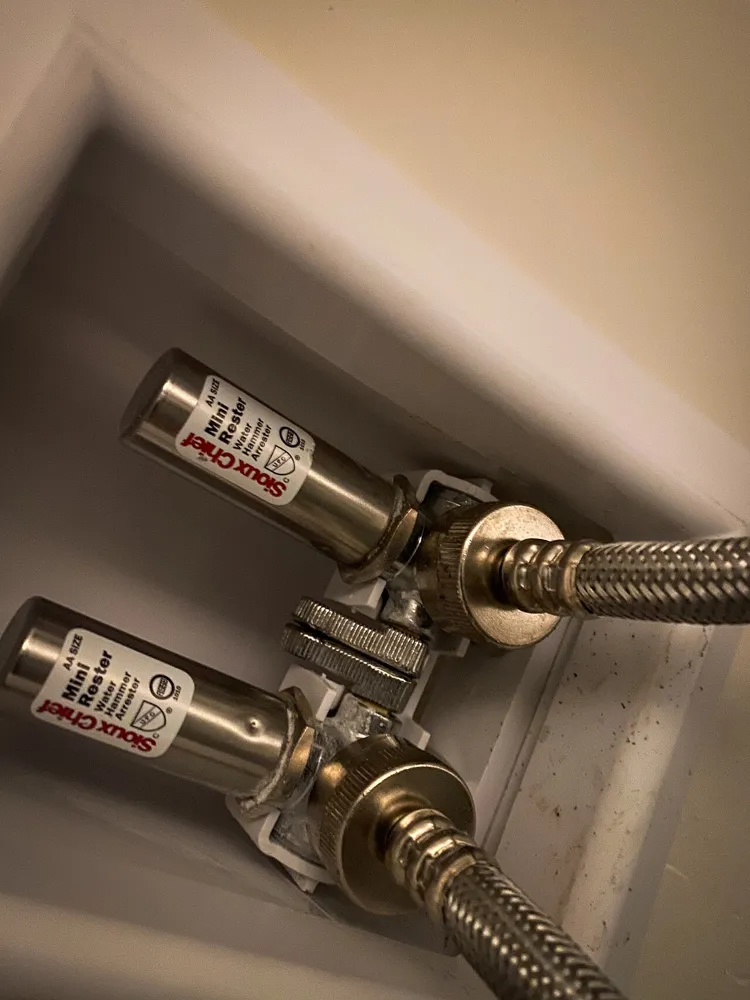
That single thud in the wall right as you shut a faucet, or as the washing machine finishes filling, is water hammer. Water moving through a pipe has momentum. When a valve stops it abruptly, the moving column slams to a halt and sends a pressure spike back through the line. Sioux Chief's engineering white paper compares it to stopping a train: the longer the pipe and the faster the flow, the harder the hit. The bang is the pipe jumping against the framing.

✓ Checked by a licensed plumber Kevin Orr, Texas Master Plumber License M-47441 (look it up)
Last reviewed
In this guide
- Which noise is it?
- Test 1: is your water pressure too high?
- Test 2: find the valve that slams
- The fix code calls for: a water hammer arrestor
- What about the old air chambers?
- Loose pipes: when the bang keeps rattling
- Why it is worth fixing, not just ignoring
- When to call a plumber
- Frequently asked questions
- Sources
The fix depends on which of three noises you actually have, so start there.
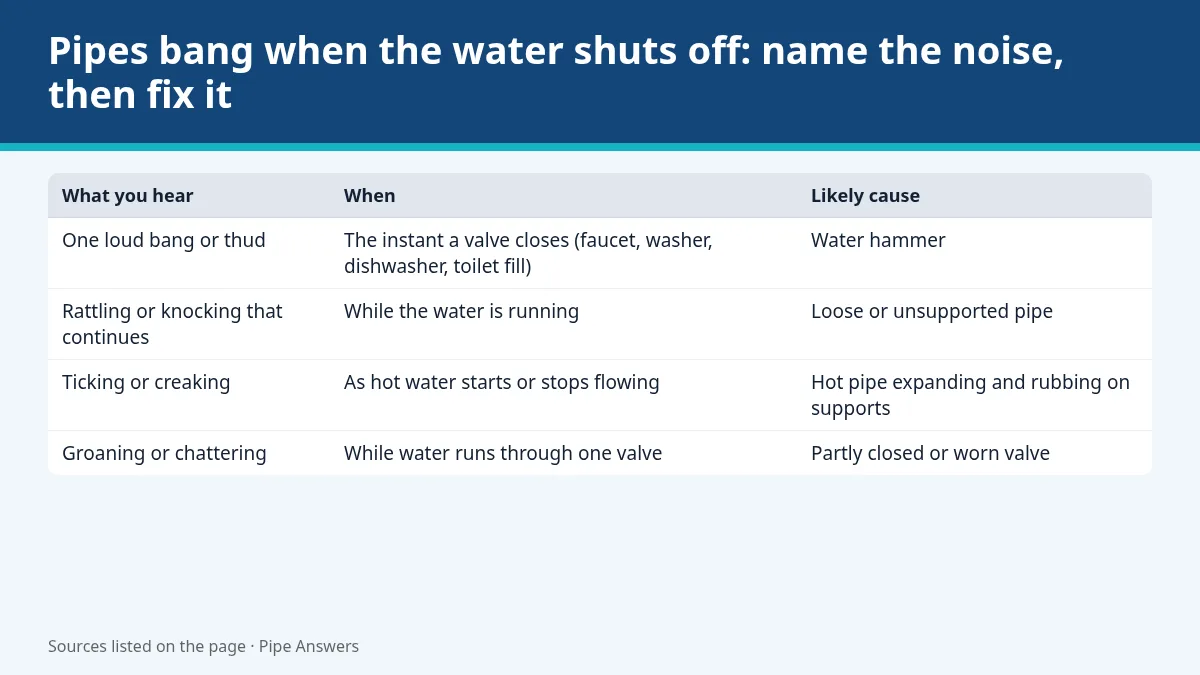 Graphic: summary of this guide, made by our team from the cited sources.
Which noise is it?
| What you hear | When | Likely cause | First fix |
|---|---|---|---|
| One loud bang or thud | The instant a valve closes (faucet, washer, dishwasher, toilet fill) | Water hammer | Check pressure, then add an arrestor at that valve |
| Rattling or knocking that continues | While the water is running | Loose or unsupported pipe | Add straps and cushion where the pipe touches framing |
| Ticking or creaking | As hot water starts or stops flowing | Hot pipe expanding and rubbing on supports | Add sleeves or cushioned clamps where pipes touch wood |
| Groaning or chattering | While water runs through one valve | Partly closed or worn valve | Open the valve fully, or replace the washer or cartridge |
Oatey's guide to banging pipes lists the same family of causes: water hammer, loose pipes, high water pressure, sediment in a water heater, and partly closed valves. If the knocking comes from the water heater itself and not the walls, that's sediment, which is a different job.
Test 1: is your water pressure too high?
High pressure makes every hammer worse because the water is moving faster when the valve shuts. Oatey says pressure above 80 psi can make pipes vibrate and bang. The model residential code sets the same ceiling. IRC section P2903.3.1 says static pressure shall not be greater than 80 psi, and it requires a pressure-reducing valve where the main pressure is higher.
Checking takes five minutes. Screw a hose-thread pressure gauge onto an outdoor hose bib or the washer's cold valve, make sure nothing else is running, and open the valve. Take a second reading at a different time of day, because supply pressure is not constant.
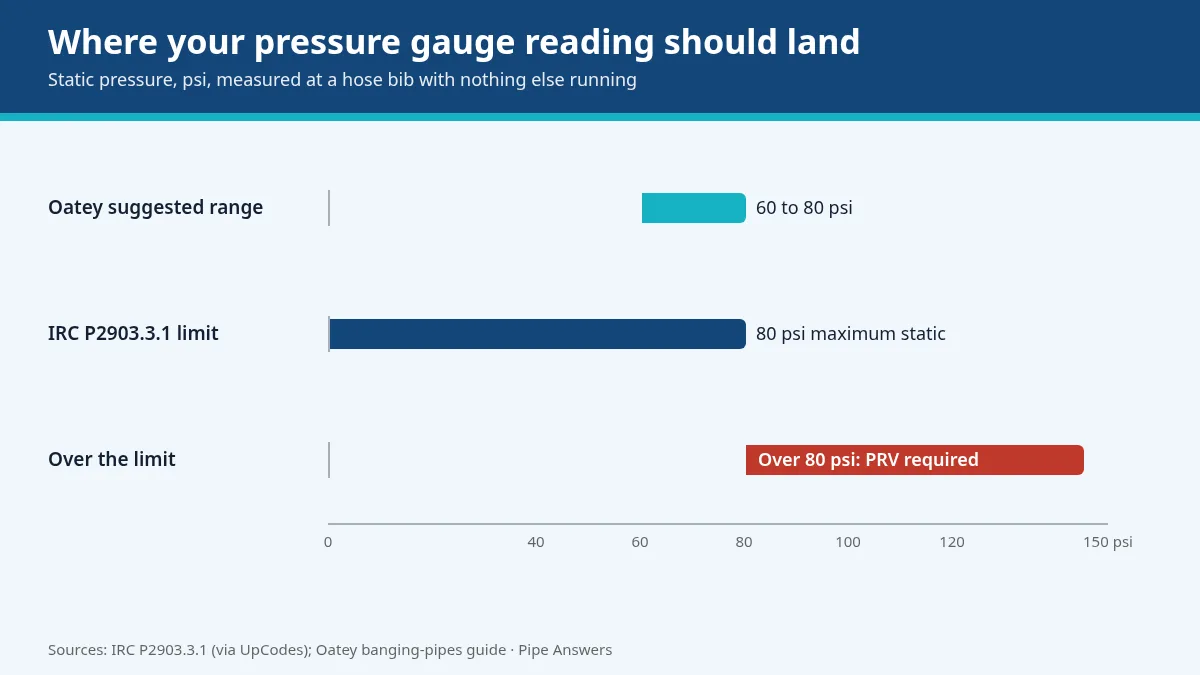 Graphic: made by our team from IRC P2903.3.1 and Oatey's pressure guidance (linked above).
If you read over 80 psi, a pressure-reducing valve (PRV) is the real fix. If you already have one and the pressure is high anyway, it may be failing. It is normally installed on the main line near where water enters the house. High pressure can also make a water heater's relief valve weep, which our guide to a dripping water heater relief valve covers.
Test 2: find the valve that slams
Water hammer is loudest at quick-closing valves. These are valves that snap shut instead of turning slowly: the solenoid valves in washing machines, dishwashers and refrigerator ice makers, single-handle faucets slapped closed, and toilet fill valves. Run each one alone and listen.
- Bangs only when the washer or dishwasher fills or stops: a point-of-use arrestor at that appliance is the standard answer.
- Bangs when you close a single-handle faucet quickly: try closing it slowly. If that silences it, the faucet is fine and the line needs an arrestor or better support.
- Bangs after a toilet finishes filling: watch the fill valve. A worn valve that shuts abruptly, or one that sings while filling, is covered in our guide to a toilet fill valve that whistles.
The fix code calls for: a water hammer arrestor
The model codes require an arrestor wherever quick-closing valves are used. IRC section P2903.5 says a water-hammer arrestor shall be installed where quick-closing valves are utilized, installed per the manufacturer's instructions, and conforming to ASSE 1010. ASSE 1010 is the product standard, so look for that mark on the package.
Inside, an engineered arrestor has a sealed cushion of air or gas kept separate from the water by a piston, a bellows or a diaphragm. When the valve closes, Sioux Chief explains, the moving water pushes up into the arrestor and compresses that charge until the momentum dies away, so the pressure spike never builds. Sioux Chief calls the piston style the most widely used. For homes, its guideline is any ASSE 1010 AA size arrestor on both the hot and cold lines at ice makers, dishwashers, washing machines and tub or shower valves.
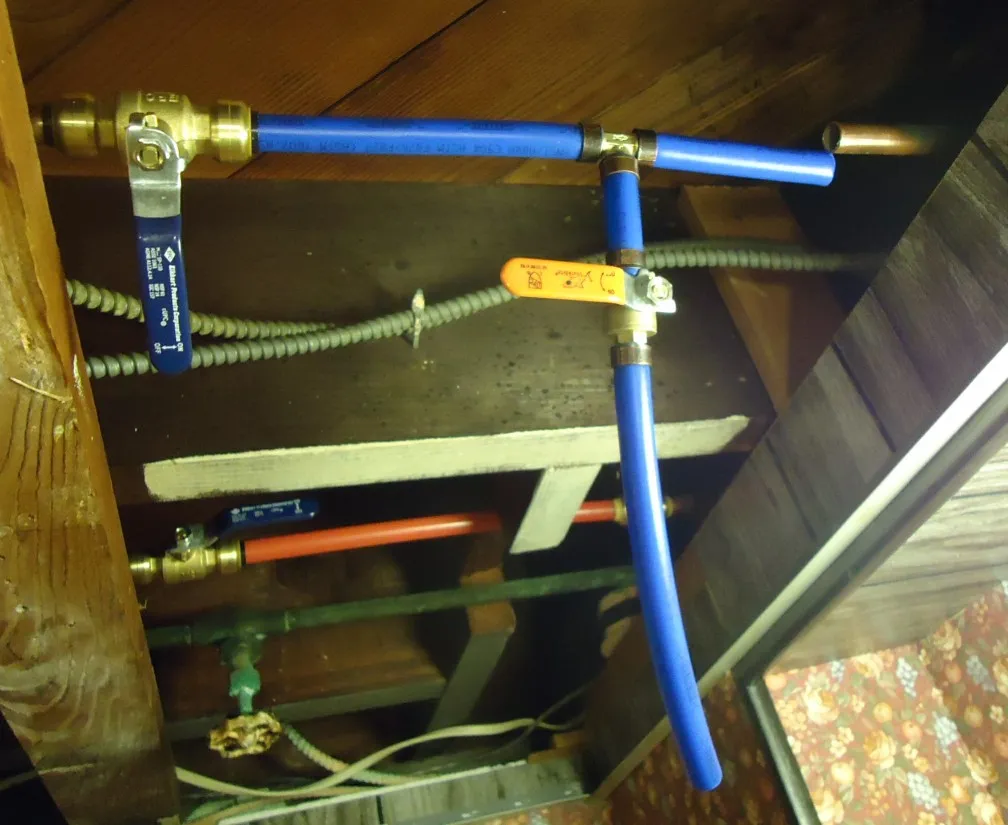
At a washing machine, this is a DIY job. Oatey's steps: turn off the supply valves and disconnect the hoses, check the hoses and fittings for damage, thread the arrestor onto the shutoff valve by hand and snug it with a wrench without overtightening, then reconnect the hose and turn the water back on. Do both hot and cold. In-wall arrestors on soldered copper or PEX branch lines are a plumber's job.
What about the old air chambers?
Many older houses have short capped pipes standing up behind the fixtures, meant to trap a pocket of air as a cushion. Oatey notes that, unlike modern piston arrestors, these traditional air chambers can lose their air and fill with water. Once they do, the banging returns. Sioux Chief's white paper quotes the National Plumbing Code of Canada, which says air chambers made from a piece of vertical pipe don't provide acceptable protection. Because an open chamber loses its air, a sealed ASSE 1010 arrestor at the slamming valve is the lasting fix.
Loose pipes: when the bang keeps rattling
If the noise goes on while water flows, or a single hammer turns into a series of knocks, the pipe is moving. Oatey says pipes should be supported at least every 16 inches and at every change in direction. Push gently on exposed runs in the basement or crawl space. Anything that moves easily needs a strap, a J-hook or a cushioned clamp. Where a pipe passes through a joist or stud, a foam or plastic sleeve stops it from knocking against the wood. Fastening loose runs won't stop the pressure spike, but it often makes the sound much quieter.
Why it is worth fixing, not just ignoring
Sioux Chief lists the parts that wear out early from uncontrolled water hammer: water heaters, temperature and pressure relief valves, pressure reducing valves, backflow preventers, faucets, solenoid valves, fittings and pipe hangers. In other words, the noise is the cheap symptom. The expensive part is the washer valve or water heater that fails a few years early. If the pipes also lose pressure at one tap, see our guide to low water pressure at one faucet.
When to call a plumber
- Your gauge reads over 80 psi and you have no PRV, or your existing PRV no longer holds pressure down.
- The bang comes from inside a finished wall with no exposed valve or pipe to work on.
- You added arrestors at the appliances and the hammer continues, which points to a branch line that needs a properly sized arrestor.
- You see a weeping joint or stain near where the pipe bangs.
Frequently asked questions
Is it normal to hear your pipes?
A soft rush of water while a tap runs is normal. A hard bang the moment a valve closes is not. That is water hammer, and Sioux Chief warns that repeated shocks wear out water heaters, relief valves, pressure reducing valves, faucets and pipe hangers over time.
Can water hammer burst a pipe?
It is rarer than slow damage. Code notes quoted by Sioux Chief say the surge can be many times normal static pressure and strong enough to damage piping. In homes the usual result is a fitting, valve or appliance that fails early, not a dramatic burst.
Where do I install a water hammer arrestor?
Close to the valve that slams. Sioux Chief's residential guideline is an ASSE 1010 AA size arrestor on both the hot and cold lines at the washing machine, dishwasher, ice maker and tub or shower valves. Laundry arrestors usually screw on between the supply valve and the washer hose.
Why did my pipes start banging all of a sudden?
Something changed. Common triggers are a new washer or dishwasher (both shut off with quick-closing solenoid valves), a failing or missing pressure reducing valve that lets pressure climb, a pipe strap that worked loose, or a valve left partly closed after repairs. Test the pressure first, since it is the quickest to check.
Smell gas? Leave the building without switching anything on or off, then call your gas utility or 911 from outside.
Know your shutoff. Find your home’s main water shutoff before you need it. Most fixtures also have their own small valve.
Sources
- Water Hammer Control (white paper), Sioux Chief Manufacturing (PDF)
- What Causes Banging Pipes and How to Stop It, Oatey
- IRC P2903.5 Water Hammer, via UpCodes
- IRC P2903.3.1 Maximum Pressure, via UpCodes
Spotted an error? See our corrections policy or email contact@pipeanswers.com.

Pipe Answers Editorial Team
Our editors build each guide from the sources listed above and check every claim and number against them before publishing. How the team works
Kevin Orr
Expert Reviewer, Plumbing
Texas Master Plumber License, M-47441 · Verify license
Kevin Orr is a Texas Master Plumber, a U.S. Army veteran and the owner of a plumbing company. In his view, good plumbing is more than fixing pipes. It means showing up when you say you will, explaining what needs to…
Related guides
-
 Leaks & Pipes
Water Under the Kitchen Sink but No Leak? Find the Source by Timing
Water in the sink cabinet with no drip in sight? When the puddle appears tells you the source: supply line, sprayer hose, drain, dishwasher hose, sink seam or sweating pipes.
-
 Water Heaters
Why Is My Tankless Water Heater Running Out of Hot Water?
A tankless heater has no tank to empty. Hot water fades when demand beats its gallons per minute, winter inlet water is colder, or a filter, scale or gas line is choking it.
-
 Water Heaters
How to Tell If a Tankless Water Heater Is Bad
Leaks inside the cabinet, ignition or overheat codes that keep coming back, and a unit near 20 years old point to a failing tankless heater. What each sign means and when to replace.
-
 Drains & Clogs
How to Tell If Your AC Condensate Drain Line Is Clogged
An AC that shuts off on a hot day, water in the drain pan, or a pipe dripping over a window are the main signs of a clogged condensate line. Checks from Trane, Carrier and Lennox.